Tag Archives: Seventh Day Adventist

Chapter 6 – Seventh Day Churches Around Berea

I believe it will be profitable to give an account of the early life, development, and work of the Seventh Day Churches about Berea. As I have before said, Berea was called Seven Day Town. It was settled early in the nineteenth century by Asa Bee, Job Meredith, Jonathan Lowther, Preston Zinn, and a number of others who kept the Sabbath.

Pine Grove Church: I do not know the exact date (but about 1850) they called Ezekiel Bee (a minister of some ability but not ordained) to move to Berea and preach for them. He accepted the call provided they gave him a farm. There were two farms offered him (which shows the religious zeal of these people). He accepted the one then owned by Preston Zinn, which included all the land on which Berea now stands. I have never heard where the other farm was. He continued to preach here until old age made it impossible. He died in Berea about 1892 at 93 years of age.

This church was called “Pine Grove Church.” It was Seventh Day Baptist, but it never was accepted into the Seventh Day Baptist Denomination as the leaders-that is the Bees and Merediths in particular-had some very peculiar notions. For example, they would not wear clothing of cotton and wool or any other mixed material. Women would not wear artificials on their hats, nor ruffles on their skirts. If a boy who did not belong to the church took a girl home, she was to mention joining the church the first night. If he did not agree to join the church the second time, she was to fire him.

Besides this, they believed that the elders should manage all the temporal as well as the spiritual affairs of the church. For example, when a cow grew old, they would say to its owner, “You had best sell that cow.” The elders were to be absolute dictators (I don’t think they ever got it to work). Women were to have absolutely no say in anything; in fact, they were not to speak in meeting. If they wanted to know anything, let them ask their husbands at home (which I am afraid would never have made them very wise).

I don’t think they ever got this to work in the church, but it cost them some new members. In about 1865 Perie and Callie went to church intending to join the church one Sabbath. Perie overheard one of the elders ask the others if they should mention artificials, ruffles, etc. The others said, “No, wait till these young folks have joined, and then we will mention that.” The girls did not join.

The Ritchie Church: There were several Seventh Day Baptists who did not belong to Pine Grove and did not like their beliefs and practices but wanted to belong to the Seventh Day Baptists. So about 1870 to 1875 they organized the Ritchie Church and built a church on Otter Slide. Some of the early members were Jake Ehret and wife, William Jett and wife, E. J. Maxson and wife, Leve Stalnaker and wife, Father and Mother, Perie and Callie, some of the Kelleys and probably some others.

Adventists in Berea: Soon after the Ritchie Church was built (about 1879) an Adventist preacher by the name of Sanborn came to the Pine Grove Church and held a meeting for about six weeks. Before he left, they organized an Advent Church. They built a church in Berea the next summer. The principal members were the Merediths, the Lowthers, Charley Bee and wife and a few others. This left the Pine Grove Church so weak that they decided to unite with the Ritchie church provided we would hold meetings month about in the Pine Grove and Ritchie churches. Several of the members did not join the Ritchie church, so about a year later Marcus Martin (a Seventh Day Baptist minister of little ability) decided to revive the old church. So he filed a key to fit it and called a meeting and started the church again. It did not last long till they asked the Ritchie church to take it over, but all meetings were held in the Ritchie church except some union meetings.

The Advents continued to grow very slowly, but always trying to tear the Ritchie church down (especially every time we had a good revival) until the early summer of 1892, when a preacher by the name of Babcock came to Berea and preached for several weeks. He was a very glib talker, very well coached in the Advent doctrine but not an educated man.

The Advents told wonderful stories about him; one I will narrate. As a young man he was working on his father’s saw mill (which was running at full speed) when he accidentally fell into the saw. He grabbed the teeth and stopped it instantly. It cut off his thumb and cut his hip, but his great strength saved him. Elder Seager heard just how it happened. Babcock’s father had an edging which had the high tenser off so that the saw was merely turning over when he fell into it and cut himself. I am telling this so that you will know the faith they had in the man.

This was the first meeting, outside of our own meetings, I had ever attended to amount to anything. I would generally go three or four nights a week. One night the preacher told us that he would prove by the Bible the next night that the “Old Dragon” was pagan Rome and that the “Seven Horned Beast” was Rome after she became Christian- so I went to hear him. He soon began to prove his point by reading from Revelations. “The Red Dragon that old deceiver which is the Devil.” “Oh,” he said, “I read too far.” I have never had any use for the Advents since then.

This revival caused the Advents to decide to have their Camp Meeting there that summer. We had a new pastor by the name of Brown. Elder Hoffman (a man of great ability and greatly hated by the Advents) preached on Sabbath morning. He preached a very strong sermon against the Advent religion. He told them he had planned to stay at Berea for over a week but that he would have to leave Sunday. The Advents said he was afraid of them because their ministers would be there at the end of the week. After preaching that night he told them he heard they said he was afraid of then. He then said, “There is but one thing I am afraid of, and that is the Devil, and I don’t suppose he will be there.” He went on to say that he could come back at the end of the week and debate the issue for one day or a week with any of them or all of them (Sister White thrown in) if they would give him equal time, but at the end of that time he would have to go to Nebraska. They said no; but after he went West, they said they would debate.

I will now tell a little joke about their trip over from Pennsboro. Mr. Kildow (one of our members) had a fine team, and they hired him to haul some of their tents and fixtures over. When they got there, they found more people than they expected; so they asked Kildow if he would be willing to bring a load of people instead of tents. He said he would just as soon haul livestock as anything else. They talked about one of their preachers (Stone) who had gone to Virginia and went to keeping a saloon. They kept saying they didn’t see how he could, seeing the end was so near. Kildow got very tired, so when a little shower came up (it was in July and very hot and dry), one of the men said he hoped it was raining on his corn. Kildow replied, “I don’t see what difference it makes seeing the end is so near.” The man got so mad he got out and walked for a mile or two. This is 58 years ago, and I fear the man’s corn got rather dry if it hasn’t rained yet.

They had great crowds and took several of our members-our Pastor Brown, Dolph Bee and family, Ida Bee and some others. They bragged that they had destroyed the Ritchie church and that they would soon all join the Advent church. Uncle Nelson Bee told Ellsworth that they said he and Sarah would soon join them. Ellsworth replied, “Yes, they took a good plan to get us. They took our flour up there and thought we would follow.” (Someone took a batch of flour during the meeting.) I attended the meeting enough till I could preach most of their sermons as well as they could; in fact, when you have heard four or five, you have heard them all. One night the preachers said that everyone of the wicked were burned up except the Devil, and that he was to be punished forever and ever, day and night (which means he was to be burned up in a day and night). This kind of foolishness does not appeal to me.

The next summer many of the Advents sold out and went down to Newark, where they had started a school from where they went out to sell Advent books. They soon ran through with their money. They were taught that they should not eat but little. They were so nearly starved that when fever broke out the doctors said there was nothing to build on, so they died. Several families with mothers gone came back to Berea. Joe Bee’s wife, Davis Meredith’s wife, and Foggin’s wife died, and several children. Some of these had lost everything they had; and Joe Bee was badly crippled, lost his home and had two small children to raise. This greatly reduced the Berea church, and they never were so strong again.

More About the Ritchie Church: The fall after the Camp Meeting, Elder Seager held a meeting at the Ritchie church. This was in October, 1892. The meeting lasted for a month, and there were about 75 conversions. A large number of us young folks joined the church at this time, and it was much stronger than it had been for years. So the prophecy that it was dead was proved totally false, as often happens.

Many of the Sunday people in the neighborhood were troubled about the Ritchie church. They said it had been the center of religious thought; all the children for miles around had made a profession there; and it had done enough already so that it should live for years for what it had already done.

One winter our pastor (Riley Davis) and the pastor of the U. B. church (Rev. Steele) held a union meeting in the Pine Grove church. After two weeks, as there seemed to be but little interest and Pastor Steele had to go to another church to preach over the end of the week, they decided that Riley should hold the meeting Sabbath and Sunday night. There was quite a stir these two nights so that the meeting went on for two or three weeks longer. Many were converted, and it looked as if both churches would be greatly strengthened.

Seventh Day Baptists and Adventists Debate: I have often noticed after every great revival, Satan makes a very great effort to destroy the work done. So it was again. The Advents had been bringing in one of their ministers as soon as a revival ended to destroy the work that had been done. This time they brought in a man who was very abusive. One of our ministers, Elder McClarin (who was a very highly educated Scotchman), had written a pamphlet exposing many of their beliefs. He was hated by them like a snake. So Westworth (that was the Adventist’s name) told in his sermon that the pamphlet was like bad soap, more lye than grease. Later in the same sermon he said that McClarin was a “liar, rascal or fool!” and that they all knew he wasn’t the latter.

Our people had grown tired of this abuse, so Ellsworth and our pastor wrote to the Missionary Board to send McClarin down (he was in Rhode Island), and we would pay his way back. When he came, they sent for the Advent preacher to come over to Riley’s. There McClarin told him to go into the pulpit and show wherein he had lied and he would apologize publicly. This he refused to do, but in turn challenged McClarin to debate the thing in difference with the Bible as the only authority. This was to keep McClarin from bringing Mother White into it, as he had been president of their college in Battle Creek and learned all about her. This debate was intended to prevent McClarin from making a reply to their charges on the pamphlet as McClarin had told them that he had to go back on Monday and the debate was to be Sabbath night, Sunday and Sunday night.

The first subject was the “Sleep of the Soul.” McClarin had the first speech. When it came Westworth’s turn (he was the Advent speaker), he made fun of the soul and said, “How does God poke a soul into a child? Does He have a lot of souls made and stored up in heaven, or does He make a new soul every time a child is born? If He does, He is a partner in the crime every time an illegitimate child is born.” By the time the evening debate was done, there were a great many people (even the Sunday people) saying it was a disgrace and that Westworth ought to be egged.

People say many things without thinking, which they should not. In the evening debate Westworth accused McClarin of having been expelled from the college. McClarin said he would show them the next day how he was expelled. Westworth became more abusive, and McClarin called for order. Mart Powell, who was chosen by both sides as chairman, said he was out of order. But Cobb, the Advent moderator, jumped up and said, “My brother has not had a fair chance, and I intend to see he talks.” I was sitting in the back of the house by the side of a fighter who jumped up and started for the pulpit with me at his heels. Everybody jumped up and started for the pulpit with fire in their eyes. Just as a free-for-all was ready to start, Westworth said, “I’ll be moderate.” So everybody sat down.

The next day Westworth and Cobb came to hear McClarin speak on the pamphlet and what had happened while he was president. Some said the Advent preachers would call McClarin a liar while he was speaking. I said, “If one of them calls him a liar, I’ll knock him down.” Ellsworth said, “You must not do that.” But I replied, “I will anyway.” So they decided that Ellsworth, as moderator of the church, should take charge of the meeting. He told them that any appeal from his ruling would go to the Ritchie church, so they said nothing. They sat right in front facing the pulpit. Ellsworth said they made faces, stuck out their tongues and did everything they could to insult him. I told Ellsworth I would not have stood for it, but he said it did not seem to bother McClarin any so he let them go.

McClarin told that when the Advent leaders found he would not accept Mother White, they cut his salary so he had overdrawn his full salary already. A couple months later he met one of the leaders on the street and this man said to him, “How are you getting along without any money?” He replied, “That’s my business,” for he said, “I know when I’m insulted.” They made no effort to pay him, so he notified them Friday if they did not pay him his full salary before sunset that evening he would sue them. Before sunset he had his pay. He then showed us a paper over a yard long with over a hundred names of those who had come to his place as a surprise party and had given him $25 in gold to show their appreciation for the splendid work he did in the school. When he finished showing this, he said, “That’s a pretty nice way to be expelled, isn’t it?”

An Egging: The Advents proposed to answer McClarin that night. As I said before, some people (Sunday as well as Seventh days) had said they ought to be egged. So some boys (both Seventh day and Sunday boys) hid on a bank and egged them. Of course, this was all wrong, but I blame the grown folks more than the boys. Two men ran them down, caught them down on their farm (the Advents). They refused to let the boys go, and a fight occurred. Mounty Bee (an Advent) struck Hayse Bee (one of the eggers) on the head with a fence rail and knocked him out (in fact, he has never gotten entirely over it). He knocked Cnood Ehret down, and he lay there (afraid he would get hurt, I think). That only left one of the eggers, Roy Bee. He seemed to think they were going to kill him, so he slipped an old pocket knife out of his pocket and began to cut them down to his size. The noise of the combat brought reinforcements to the Advents from Berea, but Roy proceeded to cut them up, too. The boys finally got away and went home. Two other boys who were with the eggers got scared and ran before the egging began.

The Advents had the eggers indicted, but they found one of them would get a trip to the pen for hitting Hayse Bee with a fence rail and swearing he intended to kill him and wished he had. So they compromised it and made the sentences light.

Some good came of it, for the Advents said they wanted us to let them alone and they would let us alone. They have kept their word fairly well, for which we are truly thankful. Their church had been going down ever since the exodus to Newark soon after the camp meeting in 1892, which I have already told about. After this trouble they began to die rapidly. They have had no meetings for many years, and the church house is torn down.

Chapter 6 – High School Years

The teenage years are perhaps the happiest and most revealing years of one:’s life. All the early home training and the lessons that have been absorbed from life, whether pleasant or sad, have had their effect. The results of the unsolicited experiences may sometimes far outweigh those planned or expected adventures.

I attended Salem College Academy for all my high school work. There were three teachers who greatly influenced me during my freshman year.

Miss “Elsie” Bond was the favorite teacher of Latin for upwards of forty years. We loved her for her great kindness and consideration to all students. You knew that, if you made an effort to recite, she would help you and would never- embarrass you when you made an error. She must have been about sixty years old when she taught me; but there was no thought about her age, nor did she ever seem to think of us as immature upstarts. There was always the feeling in her classroom of complete ease and relaxed understanding. I will have to admit that we sometimes took advantage of Miss Elsie’s kindness and didn’t study as much as we should. Even at those times, her attitude toward us did not change. With great patience, she still taught us and we went out of her room at the close of the class period with a slight feeling of remorse for our laxity.

I learned from her that patience, thoughtfulness for the feelings of others, and humility are not dependent upon conditions outside one-self; but are the direct results of an inner peace and quietness which the world cannot disturb. Did I learn any Latin? Well, of course! But judge for yourself:
love: amo, amare, amari, amatum
war: bellum
peace: pax
and: et
girl: puella
boy: puer
I am: sum

After more than fifty years, I can still recognize some Latin words!

Professor Orla Davis was a small, “wiry” man who seemed never to have had a discouraging thought or any ill-will against even those who gave him the most provocation. He taught the unromantic subject of algebra with such joy and enthusiasm that it was often an almost pleasant hour. I never liked math, nor was I a good student in it; yet I took one and a half years of algebra and one of geometry so as not to miss the homespun philosophy of this man who understood youth.

Professor Davis taught me, I realized much later, that there are times and circumstances which make the things of lesser importance become the PARAMOUNT things. He found math stimulating and exhilerating, but days would come when no problems were attempted on the blackboard because there were personal problems eating away at the vitals of one of his boys or girls. In that case, the “minor” thing became the “major” for the hour. and we learned about life.

There was a little farm about three miles out in the country where Professor Davis lived with his wife and two children. He kept some sheep and very frequently he used their tendency to follow the leader as an example to us. He would show us the necessity of leading in safe and fruitful paths when that was our function. All would be followers sometimes, and it was important to choose a wise and good leader. None of his admonition was given in a spirit of “preaching,” but always with that alive smile and the spirit of unity that goes with full understanding.

My English teacher opened up a whole new world to me. I remember with vividness many of the class periods, things that were said and my reaction to them. I remember how she taught, how she looked in a shadowy, vague way, the materials she chose to use, how she made us respond to her approaches–but I can’t remember her name! No matter, for many of God’s jewels remain nameless in this world, but not in the future one.

I learned that life is real, that feelings are much the same in every age and in every land, and that it is possible to share all the gamut of emotions through the printed page.

Two books had an unusual effect upon my life at this time, and they still influence me. First was Washington Irving’s SKETCH BOOK. I remember that I wept when my turn came to read aloud from “The Broken Heart.” It is the stirring story of a girl who 1oved the young Irish patriot who was tried. condemned, and executed on a charge of treason. He was so young, so brave, so generous, so everything, that we are apt to like in a young man. This is the picture given by the storyteller of this hero. The girl of the broken heart was pictured in such a personal way that I felt her anguish to the degree that I was forced by my faltering voice to sit down without finishing my portion of reading. If, then, his fate could awaken the sympathy even of his foes, what must have been the agony of her, whose whole soul was occupied by his image!” Not ever having had a broken heart myself, I suffered her pain with great joy and satisfaction.

Other stories and sketches were read and re-read with varying degrees of pleasure and painful. rapture. I recall the stories of “The Pride of the Village” and “The Spector Bridegroom” because their tragedies seemed to fill a need in my personality.

The other book which I “disremember” so well, but which motivated my life to a great degree, was a small gift book. I do not remember the name of either the book or the author. It was written by a missionary in Japan to express her love for her adopted land and people. It simply expressed love and beauty with so much warmth that I fell in love with the people of the world, regardless of color, language, or race. I yearned to know the people of all nations as friends. This book gave me my first real view of a great world full of people, very similar, and yet so different! People whom I hoped to know as friends. That desire has been partially fulfilled by the acquaintance I have had with people from every continent and many of the nations of the world. How their faces, voices, and personalities come back to me from over the years and miles! Their faces are black, yellow, red, brown, and white, but their fellowship and friendship are all as pure and real, constant and enduring as the mountains and oceans that separate us today.

My first experierices of “dating” came in the high school years. Certainly the most of our plans in that day could not be considered very “groovy” today. We never single dated. We usually went for an afternoon walk “down the tracks” to Lovers’ Leap, had a game of Rook at home, or went to a program at the auditorium, so there were always four of us and perhaps many more.

I had a special. girlfriend, Ruth Davis, and one of us never dated unless we both did. The boys made their plans together- also, even to the gifts they would give us. One Christmas they gave us pocketbooks another time we got gold pen and pencil sets. The day we graduated from high my boyfriend (I can’t remember his name, although we had dated for three years) asked me to go walking with him alone and I went . I was very sorry that I did, for- he asked me to marry him and that broke up our good foursome.

My dad never made much money in his teaching profession, and all the family tried to help out by doing whatever work could be found. Thus, I spent two summers working in the Battle Creek Sanitarium in Battle Creek, Michigan, as a waitress. I cannot remember what my salary was, but we did receive pretty good tips, for the guests there were usually very wealthy. The hospital and hotel were under the direction of Seventh Day Adventist doctors who had very definite ideas about health foods. No meat was ever served there. but their meat substitutes looked appetizing and for a period tasted delicious. I recall that the first time I left the grounds to eat in a public cafeteria, I bought chicken pie, steak, and liver. I felt like crying when I had to leave some of each kind of meat on my plate.

I had two “growing-up” experiences in Battle Creek. The first was financial and the second was emotional or social. We were paid every two weeks and I bought my meal ticket, paid my room rent, kept a small amount of change and sent the rest home. One payday, I went to town with all my wealth in my pocketbook and I lost it! It had a card in it with the name and address of the family where I roomed. That was lucky, for the woman who picked up the pocketbook knew the family and contacted them about it. Thus, I got my possessions back. Lesson number one: you must protect your belongings with great care.

I had a very lovely girlfriend there, Le Moyne Stevens, and she arranged a date for me. We doubled and went out to the lake for a carnoe ride. It was a very nice evening until we went back to town and left Le Moyne and her friend at her place. Then the young man I was with drove to a park and expected payment for the evening of entertainment. I saw a man walking in the distance and I threatened to scream for help if he did not start the car and take me home immediately. He was very angry, but he feared the results if he didn’t do as I said. He called me a “dumb, foolish kid, ” and I surely was to have been caught in this situation. (He was a prominent young doctor in the hospital there.) Le Moyne quit her friend because he brought such a “sorry” date for her friend. Lesson two: you can’t always judge people by their looks, their reputations, or even their friends; watch out for yourself.

Athletics in those earlier years was mostly for exercise. Our girls’ basketball team never played more than a half dozen games; but oh that practice was fun! Our uniforms were something to behold: white middy blouse with a black tie, black, very full, bloomers. We bloused them just above the knee and then they hung well below the knee. We wore long white stockings with our white tennis shoe. All of this was topped by a wide black ribbon tied around the hair to keep it in place. I played guard with more pleasure than skill.

Orations, debates, essays, and readings had a very important place on our campus. We had two literary societies which each met each week to foster skills in these arts. During Commencement week each year, a contesit was held between the members of these two groups. The rivalry was very strong. As a high school junior, I won the reading contest against a college senior. She was very polished and sedate. I don’t remember anything about her number, except that she forgot once and had to be prompted, and that error on her part gave me the win. I had an elocution coach who prepared the reading for me and trained me to do it to perfection. I still remember it. An old West Virginia couple made their first trip by train to Chicago.

I won the right to represent my society, “Excelsior,” in the contest by giving the reading, “The Bear Story,” by James Whitcome Riley. 1 have used it, or at least variations of it, through all the years since that time. I guess most Lee College students have heard it during the years.

When I was a senior, I won the oration contest. My messsage had to do with the needs of the rural schools in West Virginia. It was a challenge to the youth to bring about better learning conditions for the country children. I remember one sentence which started, “If you can make a better mouse trap, the world will beat a path to your front door; if you can produce a better school, the present and future generations will praise you…” I cannot remember for sure, but I believe the boy I beat in this contest became a United States Senator from West Virginia, Jennings Randolph. I will have to admit that he has done far more with his public speaking than I have.

Play production was another very interesting and important part of our school life. I never missed an opportunity to be in a play. We never- went into elaborate plays, but they were not all comedy. I remember we did Ibsen’s “The Doll’s House,” even going to a nearby city for one performance. (We had one fellow in that cast who was about seven feet tall. He was a spectacle!)

Our- senior class produced two one-act plays. One was Chinese, the story of the “Blue Willow” dishes. It was a beautiful thing with authentic Chinese costumes and very careful training. I have pictures of the cast, but of course they are not in color. The other play had an Irish setting. I was an old woman who was hard of hearing. That caused all the trouble and hilarity of the situation. Weeks of practice had made the production as perfect as our inexperience would allow.

So ended, in 1922, four years of high school and the finality of dependence upon the family. I went to summer school and got a “Short Normal” and began teaching the next fall.

World War I had come and gone before I got out of high school. Near the close of the war, Brady had been drafted when I was a freshman. Troops were moved to the east coast by train.,and Salem was on the main line from west to east. We saw long troop trains almost every day for months. T’here was a “switch” where trains were forced to wait for the passing of other trains, and frequently a troop train would be on the siding for a few minutes. We always went to the tracks and talked to the boys as they waited. If we had anything baked, we took them refreshments. It seemed to be our patriotic duty to cheer them by our friendship and interest. Some of them had few friends and no family, and they would take our addresses and write to us for a while.

Chapter 1 – Country Life In The Early Twentieth Century (A Child’s View)

The covered bridge over the Hughes River was the meeting place for the children of the little Ritchie County community of Berea, West Virginia. The boys must always show their prowess by walking all the way over the founded beams that supported the side of the roof of the bridge. When they had successfully maneuvered their way across (it was very seldom for any one of them to fall the fifteen feet to the floor of the bridge, and when they did, Old Doc quickly splintered their broken arm), it was time for the girls to try their skill. They were never permitted (by their brothers),to go more than a third of the way up, and then they could sit quietly there to rest on their laurels before backing down to the safety of the bridge floor.

There was an open gas flame on a pole between the village store and post office. Since this was the only outside light in the community, it was the gathering place on summer evenings for the children. Fireflies, moths, and all other flying insects also considered this the proper place to spend, and I do mean spend, a worthwhile hour or two.

As the children played, the men discussed the events of importance. Politics always came in for its fair share of argument. Teddy Roosevelt and his exploits were either the greatest or the world’s worst, depending upon which “Party” you supported. News of the outside world would arrive by way of the mailman about twice a week, but in between times the “old news” would suffice for heated discussions.

The mothers of the community rarely entered into village play and deliberations. There were always stockings to be darned, trousers to patch, and a million-and-one other things to occupy their time. They baked their own bread for the family, washed their clothes on a scrub board and ironed them with a “flat iron.” They dried and sulphured their fruit and vegetables that would suffice for food during the winter months. (Not many things could be canned in the early twentieth century. Pork was preserved by salting and beef by drying.) Fodder beans (dried beans in the pods) was a staple food for winter meals, and I still like them. The women also made all the clothes for the family with the exception of a “Sunday suit” for Dad and the boys after they “grew up.”

There were a few days of the year when the women folk could really shine. Among these special occasions would be: First, there was the thirtieth day of May picnic when buggies and wagons would come to Pine Grove from as far as five miles away. (I must tell you a little later how ice cream was provided for this feast.)

Second, the community Christmas tree at the school house. There would be a program using all the local talent. The tree was lighted with candles that glowed with a far greater splendor than any of the modern day lights. The gifts had no fancy wrappings, but were just hung from every branch and piled on the floor under the tree if they would not hang. After the program in the school house, fireworks were put off from the hill overlooking the village. There might be a half-dozen “Roman candles,” dozens of “sparklers” and firecrackers without number.

Third, there were bean stringings, apple cuttings, and quiltings which were days for social gatherings in which the women would really show their skills. Perhaps five to ten bushels of beans would be picked and the neighbors would come in to help prepare them. There would be music and games for the young folks and work and talk for the others. The next day these beans would be washed and partially cooked and placed into a large barrel and left to sour. After about three weeks, they would turn into delicious “pickled beans,” and would be eaten every day during the long winter months. (If you don’t think they would be good, get a recipe and make a gallon of them. Your family will enjoy the change.)

Another big barrel was used to sulfur apples. If you have smelled sulfur, you will wonder how anything could be eaten that had been around that terrible odor. When the proper amount of sulfur was used, the apples remained white and had a fresh taste when cooked. Bushels of apples were dried. You can still buy dried fruit in stores, peaches, apricots, prunes, and even apples, but they turned very dark and had a different taste when cooked.

Nearly every home in the community would have a quilting day during the winter. The women folks would piece quilts all year and finally when four or five were ready to set in the frames, the neighbors would be invited in to help quilt them. It was important for the young ladies to learn to be good quilters if they wanted to be recommended to the most eligible young men. All day long the sewing and laughing and talking continued. When evening came, this family had new quilts to keep them warm.

I guess there may be one or more strange characters in your area–there was, and is, in ours. Poor Toody lived in anticipation of these special days and she never missed one. She wasn’t much good with the needle, but she was “S-1″ at the table. She would manage to get to the “first” table and remain through the second and third shifts. When everyone else had finished, Toody would finally leave the table weeping and when asked why she wept, she would say, “It is so sad that I can’t eat more when there are such good things left.”

The farmers assisted each other at wood cuttings, corn huskings, and hay harvesting. These were family gatherings because the women came with food and brought the children along. The boys and girls were responsible to draw water from the dug well and keep the men in the field supplied with fresh drinking water. The best food available was provided on these occasions, even pie and cake.

Let me tell you how a group of people who work together can provide special treats for themselves. In our locality there was an old one-room log house. This house was filled with sawdust. When the river froze over solidly, the men would go down and cut out chunks of ice and store them in the sawdust. Each participating family would be permitted to remove a certain number of blocks for his own use. On the 30th of May, ice cream would be made for all the picnickers. Sometimes there was enough ice left to have ice cream for the 4th of July also!

The three-room school house in the heart of the village served the countryside for miles around. The pupils varied in age from 5 to 20 years and the teachers were sometimes younger than some of their charges. I was lucky, though, for Dad was my first teacher. We lived in sight of the school and I was permitted to go in the fall before I became five. I recall asking to be “excused” and then running home to get a “piece.” One day I whispered and disturbed Dad and he punished me by placing me on the corner of his desk with a “fascinator” tied around my face so I couldn’t see. (A fascinator was a head scarf made of a long narrow piece of woolen cloth.) It was a serious punishment for me to have to sit quietly and have no one with whom I could whisper.

The village store was a treasure house to the youngsters. They always had candy: rock candy that looked and tasted about like a rock, except that if you sucked carefully on it, you got a faint taste of sugar; maple sugar candy that was molded into exciting shapes–hearts, stars and cubes–and it was really good, even though it had been left in the open to dry out by the month so that it became as hard as the rock candy; several varieties of stick candy were always awaiting the one who had the nerve to try to bite them; green pickle candy was the real treat. It looked like a small pickle and was as sour as a homemade pickle. These precious tid-bits came pretty high–one egg carried carefully in the hand and presented to Mr. Jackson could be exchanges for two “pickles” and they could last all day if you gave yourself a little rest before you started on the second one.

Even a community of thirty-nine people had its characters. There were Uncle Jake and Old Doc, Aunt Perdillie and Aunt Lovie, these were their real names, who were the “salt of the earth.”

Uncle Jake liked children, I guess, and he was always after them about something. He walked with a cane. This cane had an especially big crook in the handle, and any child seeking to slip by Uncle Jake for any reason at all would find himself brought face to face with the old man by the force of that crook around his neck. Every child feared him, but no one ever heard of any harm done by him to anyone.

Old Doc had delivered all the babies in a fifteen-mile radius and watched them grow into men and women. He always made each child feel he was someone special. To every girl he would say, as he patted her head, “Pretty as a peach with the fuzz rubbed off.” To the boys he would say, “Oh, that muscle is really developing.” Any time a child had to be taken to his office, which was in a little white-washed shack in his front yard, there were some candy pills doled out into his hand, as many sometimes as a half dozen, and they were sure to do the trick, even if you were still sick a week later.

Aunt Perdillie and her husband, Uncle John, lived in a two-room house in the heart of town. He was paralyzed and unable to walk, so he sat all. day long in his rocking chair while Aunt Perdillie went out to do a few chores for neighbors to earn their living. They received an old-folks pension of $5.00 a month, so with the things given to them by neighbors, they got along. She would give a penny once in a while to a child who would sit with him at times when he was feeling “poorly.” She was highly respected for her devotion to her crippled husband. Children would sit by the hour in the shade of the house on a long hot afternoon, soaking up “local color.” There was no better way to her the news, for she was the town “gossip.”

Poor Aunt Lovie was renowned for her stinginess! When she had guests for a meal, she could be expected to say, “Help yourself to the butter. There’s more in the cellar in a teacup.” She was the guardian of her precious loaf of bread, for she kept it in her lap and if someone asked for a slice, she would cut it and pass it over with the remark, “I don’t like to cut any ahead, for it dries out so bad.” Her idiosyncrasies were always good for a laugh when the men gathered for a session.

Religion played an important part in the lives of these country people. There were two established churches, and when a third one, -Seventh Day Adventists, sought to establish a congregation, the holy ire of the community was aroused. The new minister was forced into public debate and thoroughly humiliated by the men of the community who tricked him into “deep water” out of which he was unable to swim. Their objections to this new doctrine did not concern the keeping of the Sabbath, for the majority of the community were Sabbath-keepers, but they objected to the ban on the eating of pork and the doctrine of “soul sleep.” To this day, the Seventh Day Baptist group still have a church and the Adventists are only mentioned in connection with reminiscences.

The yearly “protracted meeting” was held in the late fall when all crops were gathered in and the work was slack. From every direction you could see the lights converging on the “church in the dell.” Each family brought a lantern to see to walk by and to use in lighting the church. Time had been spent in every household some time during the day in filling the lantern with coal oil and (:leaning and polishing the globe so as to get the best possible light from it. Sometimes mischievous boys would turn the wick up on some lanterns to make them smoke so no light could penetrate the globe. They were considered the Is roughnecks,” and prayers were said for their souls. The meetings frequently continued for six weeks with much rejoicing and an “experience meeting” each night when the grownups got to testify about their personal lives. (The truth about this was that everyone there already knew so much about each one as he knew about himself–sometimes it agreed with his testimony, and sometimes not.)

This meeting afforded the main social opportunity of the year. The young men lined up at the door to ask the young ladies of their choice if they might “see them home.” The two or three-mile walk through the mud or snow–whichever it chanced to be–gave ample time for exciting conversations and spills and pick-ups which provided a little harmless physical contact, always in the close proximity of the rest of her family (and probably his). The old folks and children were preferred as chaperones and permitted to carry the lanterns while the courters walked behind in order to make the most of the lantern light, so they declared.

The grist mills was always good for a few hours of interesting perusal if nothing else developed. The mill pond, formed by the dam, was too deep for a playground, but at times it was possible to walk across the top of the dam a few times without being caught. That was as exciting as the visit of a stranger in the village, and almost as rare. The great mill wheel was always turning, for there was never a shortage of water in the river. The splash, splash of the water as it came off the wheel could carry a contemplative child into the land of dreams where all sorts of exciting things took place.

When the mill was running, it was an exciting place to be. The farmers brought their grists of corn and wheat and stacked them inside the great dusty room. A bag at a time would be opened and poured into the hopper. Then the real entertainment began as one could run from place to place watching the progress of the grain as it was turned into meal or flour. Eventually it poured out of a chute into a bag and was ready to be used for baking bread, cakes, cookies or pies. The miller, in his flour-covered clothes, always divided the finished product, keeping one bag out of four for his share as payment for having ground the grain. The little country stores for miles around would stock their supply of flour and meal from his “share” that was always piled high in the storage room.

Winter was a wonderful time in this remote section. Ice skating and sleigh riding were the natural recreational outlets for about two months of every year. Even school days did not prevent the youngsters from skating and sleighing, since the river was near enough on the one hand, and the “hill” was in easy distance the other direction. So the noon hour afforded ample time to enjoy whatever sport was best at the time. I doubt that the lunch pail got much attention those days, only something that could be consumed “on the run” was appreciated. Practically every child owned a pair of ice skates, store-bought, and a sled, home-made, and learned to use them before he entered school.

The grownups were more likely to use the “river” and the “hill” at night. They would build bonfires and make a real social occasion of it. Some of the families had sleds drawn by one or two horses, in which they transported their families to church and other necessary places. A good layer of hay was placed in the bed of the sleigh and everyone crawled in and covered with quilts and blankets against the cold winds that were generated by the fast movement of that plow horse that was doubling as a racer for this occasion.

Many important subjects came in for their share of discussion around the stove in the store, mill, or blacksmith shop. The weather was always good for an opener, whether it was hot or cold, wet or dry. “Crops” would always strike fire if certain farmers were present, who invariably had the “most corn to the acre,” the biggest “punkins,” and so forth.

One subject that had top rating for several weeks was “Halley’s Comet.” The story was widespread that when this comet approached the earth, it would swing around and its tail would touch the earth and set it on fire. It would be the end of the world. This was discussed pro and con by the hour while the appointed time for its appearance drew near. The children were spellbound as they listened to the tale–afraid to hear it, but too curious to run away and hide. There were nights of troubled sleep for the young fry who talked in whispers about what it would be like if all the world was afire. Would the river be a safe place to hide? (It was as much as fifteen feet deep in spots.) Or would it be better to find a deep cave to hide in while the fire burned? The night the comet was to be visible passed without incident, and there was an unconscious sighing of great relief when the population awoke as usual and found themselves still alive and everything normal.

There was no such thing as a daily newspaper in that farming area, but there were a few families who took weekly and monthly farm and family magazines. GRIT was a great favorite as an all-around weekly news and specialty paper. YOUTH COMPANION carried a serial story and other features of interest to the whole family. The day the companion came was a special one, for everyone hurried a little faster with the chores order to gather in the “sitting room” for the reading of the continued story. One member read aloud, so all could get the exciting details at the same time. Today’s theaters would do well to secure some of the reading talent that was developed in those evening sessions! The best reader was urged to do the honors, since a great deal of their pleasure depended upon the romantic atmosphere provided by the voice, accents, and speed of the reader. There were some homes where even the best reader left much to be desired, but if it happened to be the story of an Indian raid, a slow monotonous voice reading, “As I stared toward the window, there appeared two feathers moving upward , and then the hideously painted face of a savage came into full view.” would help to ease the pain of suspenseful anxiety.

By the way, have you ever experienced the feeling of contentment that “all’s well with the world” sense of satisfaction that accompanies group reading? Get a few compatible companions and try reading poetry, a new novel, a book on present-day trends in race relations, a book on prison life in a Communist country, and see if life doesn’t put on new interest and emphasis.

Music had an important place in the lives of these contented people. There were few instruments in the community–most of them pump organs. Some churches had organs, and a few homes were so blessed, but few people learned to play them. Perhaps as many as two women would be able to play the church hymns. There was one accordion in the community, but it had little in common with the present day instrument. It had twelve (?) notes and two bass notes. (I still have one that my mother used.) Singing came natural with these people. Nobody had a trained voice, but nearly all could “carry a tune,” and they enjoyed doing so. Certain people were considered leaders because they owned a pitch-pipe, which would give them the proper pitch for starting a song. This was used when no instrument was to be played.

After the first frost fell in the fall of the year, a new and interesting chapter of life began. The gathering of nuts was the children’s contribution to the winter supply of interesting food. There were chestnut, hickory nut, walnut, butternut, and hazelnut trees in abundance. (Now all the chestnut trees are dead from a blight, and only a few of the others have survived the years.)

The most frequent and enjoyable excursions were made to get chestnuts. Those trees were large and grew outward more than upward. Longfellow described it when he said:
Under the spreading chestnut tree
The village smithy stood

Chestnuts grew in round shells, or envelopes, that were completely covered with prickly burs. When they were ripe, these burs fell to the ground and frequently burst open on impact to reveal four sections which contained one nut in each. These burs were fully lined with a soft substance which felt like velvet. At times, the nuts seemed so content with their soft pleasant home that they were reluctant to leave it. In that case, you took a stick to force them out while you held on to the bur with your foot–if you had shoes on.

The pleasure of gathering these nuts was almost eclipsed by the pure delight of eating them. They were good in so many different ways. On long winter evenings, chestnuts Would be placed in the coals in the open fireplace and heated until they would burst open. It took careful watching to eat a hot one without getting burned on the shell. If there was no fire for roasting them, they Would be boiled and the taste was quite delightfully different. Then, of course, they were available for stuffing the Christmas turkey or, more completely, the rooster.

It was great fun to gather the hard-shelled nuts: hickory, walnut, butternut, and so on, but they were tiresome to crack and pick out.

Long hours of confining work were required to get a dish full of those nuts prepared for use in baking or candy making. They had very thick shells, and it took a hard lick with a hammer to crack one. (The shells are much like the shell of a Brazil nut, only thicker and tougher.) You had to hold the nut between your fingers on a piece of iron or stone and then whack it. Many fingers have been badly bruised in the effort, and thumbnails lost in the process. Then the tedious task of picking out the kernels began. You used a wire hairpin or a nut pick to dig the kernel out of its hiding place. The next time you go to the store and buy a little plastic package of black walnuts, remember what it cost someone to prepare them.

One of the joys of springtime was following after the plow. “Tasting” the feel of freshly-turned earth on bare feet! All winter you had worn high shoes that cramped your thoughts, if not your toes, but now for the first time since last fall, those toes could enjoy their freedom again.

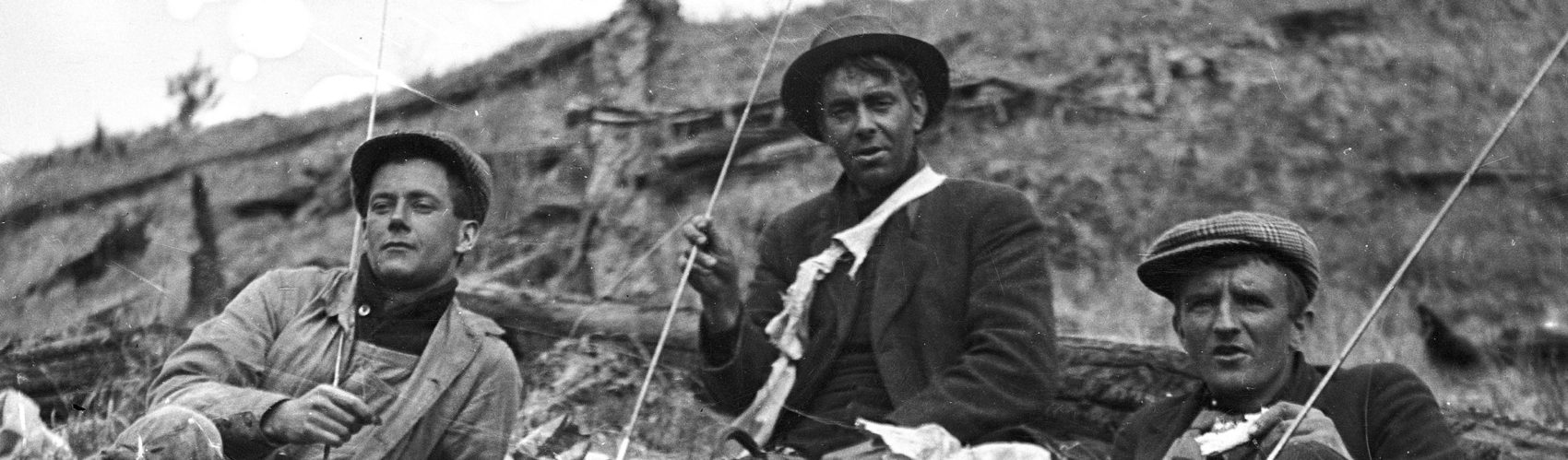
The earthworms that were plowed up must not be wasted, either. The fishing holes were beckoning. Many frying pans in the community would be full of tobacco box and black sunfish the next few days. (People call these fish bass today.) What a glorious way to spend a lazy afternoon–sitting on the river bank with a home-grown fishing pole in your hands and a string of three or four five-inch fish flapping around in the water beside you! Then is when your dreams of the future really blossomed, the fruit might never mature, but you had the pleasure of the blooms, anyway.

The words “hay harvest” bring varying responses. Some of them are happy; some are filled with dread and fear; some recall hard work and sweat, and there are many memories of pleasurable experiences. Children had certain pre-arranged jobs connected with harvesting. There was always the continuing job of carrying water from the spring to the workers. If they were working as much as a mile away from the house, dinner Must be carried to them–otherwise, it Must be served on the table. Someone had to ride the horses to haul the hay shocks to the stack area, and of course the small fry were selected for the job so that everyone big enough to “pitch” hay would be available for that job.

Two things were dreadful to me about those haying days. The sweat bees stung my legs as I rode bareback on the horse. I was so afraid of them that if one was flying around me, I was likely to forget to guide the horse to the right place. A few tears were inevitable because, if I got stung, I cried, and if I failed to guide the horse properly, I got scolded and I cried. And then I was always afraid I would see a snake. My brothers were older than I, and they assured me they would protect me, but there was always the idea that they might be far away.

Nell was a fine horse. She could travel well in a buggy, and she was a five-gaited traveler. My Dad was very proud of her, but she had one big fault–she was afraid of cars. On the rare occasions that we would meet a car on the road, she had to be held by the bridle and talked to, patted, and reassured. We were always sent scampering up the bank above the road for protection as soon as we heard a car approaching. (You could hear them a mile away in those days.)

Old Nell and I had a mutual understanding with which Dad could never agree. As soon as Nell saw me approaching with a bridle, she would lay back her ears, bare her teeth and run at me. I never went far from the fence and always made it over safely before she got there. Dad insisted she would not hurt me and he would send me back again and again. If my memory serves me right, I never did prove that she wouldn’t eat me up. One of the boys always ended up catching her and then I could ride her or lead her anywhere.

Country children were taught to be afraid of certain things. My list included: mad dogs, gypsies, snakes, buck sheep and bulls. In our wandering around the country, we avoided fields where there were sheep or cattle, so that was usually taken care of. But we couldn’t tell when a band of wandering gypsies might come through. (I remember seeing one band off three wagons when I was very small.) Any time we were on the road and heard a wagon coming, we visualized gypsies until it came into view and we knew the people.

A boy in our county, we didn’t know the family, had been bitten by a mad dog and died a terrible death. So this idea of fear would fill my thoughts if I chanced to be alone for any distance away from the house. I suppose I have run many miles fleeing from an imaginary dog. I never saw a mad dog until many years later, and then it wasn’t a strange dog, but our own.

Dad had a sister, Aunt Callie, her name was really Calfernia, who lived in the nicest house in all the Countryside for miles about. It was built on the top of a steep hill about three miles down the river from Berea, our little village. When the weather was good, you could drive there by buggy or wagon, or ride horseback. Most people walked over the hills and avoided crossing the river, which was necessary if you went by road.

To my childish mind, this great two-story white house was a castle in the clouds. It had a wide stairway with railing that was perfect for sliding, providing you didn’t get caught! If you did get caught, once in a long while, you were likely to stand up for a few hours in order not to add to the pain that was present with you.

The rooms were large and filled with interesting things which had not been made for children’s play toys. Two of the most interesting rooms were forbidden territory except on very infrequent occasions. The parlor was reserved for very special guests, which I never was in those days. Recently we have gone back there twice for a few hours, and that was the room we were taken into. I had to ask to see the kitchen and dining room. Cousin Julia is now dead and only her sisters, Conza and Draxie, and Rupert, their brother, still live there.

In 1965 when we visited there, after a bumpy and dangerous trip up the hill, we parked the car in the yard. Conza came out to warn us to be sure all windows were closed; otherwise, we might not have any upholstery left, for one of the horses was in the habit of eating all such delicate repasts. We didn’t know how smart the horse was, so we locked the doors, too.

There were special chairs covered with velvet and lovely soft cushions in every one. A table held an “Aladdin lamp,” which was a special oil-burning lamp that was much better than the ordinary ones used in the rest of the house. On the walls of this room hung the prize pictures of the members of the family. They were “enlarged” and framed in wide gold-colored frames about two by three feet, and some of them were larger. Those pictures are still there, and on the table stand is the same velvet-covered album of pictures that was their pride and joy a half-century ago.

Aunt Callie and Uncle John have been gone many years, and their children who still live there are now older and more feeble than I remember- my uncle and aunt. No wonder, for they have worn their lives out in that beautiful but inconvenient setting. Even in this modern day they must still carry nearly all their drinking and cooking water from a spring at the foot of the hill.. They have a drilled well on the back porch, but it never would supply more than a few buckets of water a day during the must ideal circumstances. When I was a child, I carried many buckets of water up that winding path. The girls of the family, Julia, Conza, and Draxie, made a large wooden yoke which they placed across their shoulders to aid them in this difficult task. A rope hung from each end of the yoke, with a hook on it, which they placed in the handle of the bucket; thus, the weight of the load they carried was distributed across their backs. I could never try it, for it didn’t fit me. Even as a child, I thought this made them look like “beasts of burden,” for it was much like the yoke they placed on the oxen when they hitched them up to work.

Washday was an event. The dirty clothes were carried to a level spot by the spring; a fire was built under the huge copper kettle which was filled with water. The clothes were placed in a tub with cold water and left to soak while the water heated. The other tub was filled with hot water, just hot enough to make the hands turn red but not blister, and then the washing began. Home-made lye soap was used and the clothes were rubbed, piece by-piece, on a washboard. The white clothes were then boiled in soap suds for about a half hour and then put through two tubs of water to get all the soap out. The wringing was all. done by hand, and those baskets of clothes were heavy when they were carried up the hill to hang them up to dry! In the winter, rain water or melted snow was used and the kitchen became the wash house.

The early spring was a wonderful time to visit at Aunt Callie’s house, for they made maple syrup. I suppose the month varied some, for the sap must be gathered just as it began to move in the trunk of those sugar maple trees. The days would be warm and sunshiny and the nights quite cool. A dozen or so sugar maples would be “tapped” and buckets hung under the spout they placed there. The sap would continue to drip for a week or so, and the buckets would have to be emptied twice a day. It tasted like lightly sweetened water to me. Now, as I remember it, I think it must have been somewhat like coconut juice from a freshly picked nut. (I don’t care for it, either.)

It took long hours of boiling this sap to bring it to the stage of maple syrup. I think one gallon of sap would make about one-half pint of syrup. It was used in baking, on the table, and best of all, it was made into candy. I would be given a small dish of the hot syrup to beat and mold into candy for myself. They sold many pounds each year, molded in little heart shapes. When it had been boiled down and molded, it was the color of light brown sugar, but the taste was wonderful. Nothing that we have today tastes as good as I remember that did.

There was another juice that was boiled down for syrup in those days, also. Sugar cane was grown by many of the farmers and then in the fall, when :it was at the perfect stage of ripeness, it was cut, ground, and the juice boiled for molasses. They would make molasses for the whole community at one time and place. Someone had a large vat, which must have held a hundred or so gallons. A large hole was dug in the ground and fire was kept burning (wood was the fuel, by the way) under the vat for several hours until the molasses had the proper consistency. It took two to feed the fire and stir the syrup. Long-handled wooden paddles were used to stir the molasses constantly so it would not burn. We children would be permitted to use our own little paddles to stir the top, with the end in view of licking the paddle. I never liked molasses, but I did enjoy pretending to “lick” along with the other youngsters.

All of this has been written in an effort to recapture some of the charm and homespun pleasures of the common people of the non-urban population of the early twentieth century. You don’t need to long for those good-ol-days; just take time to visit some of these same areas today and you will find the essential atmosphere has changed but little. There will be some electric lights and appliances, some telephones, passable roads all year round, and a car in the barn, but the people who are still there have retained their same philosophy and simple way of life. You will find last year’s Sears Roebuck catalog in the outhouse, nailed to the side of the wall, for your convenience. The biggest change would be that you would find no young people. Many houses are empty and going to swift ruin that used to ring with the impetuous laughter and joy of family life. The old folks died and youth moved away; for urban life beckoned them!

I guess this retrospective view has turned to be like a session on the psychiatrist’s couch. The question is: Will these recollections do me or anyone else any good?