Tag Archives: fish

Chapter 18 – Teaching Experiences, 1936-1945

Bug Ridge School-Teaching Three Generations: I got the Bug Ridge School the fall of 1936 and had a very nice time. Brady and I used a little politics to get it. One of the board members ran for assessor and offered me the deputy job if I wanted it. He said I had been treated dirty. Brady asked the board member how he would like for him to work against him. He said “No, no.” Then Brady told him of the offer and that I would accept it if I was to get no school. He said I would get a school, and I did.

It was during the winter of 1936 that Bond [Ashby's oldest son] stayed with us for a month and went to school to me. This meant that three generations went to school to me [Jennie, Ashby, and Bond]. I had a number of cases where a father and child and in one case where both parents and children went to me, but this was the only case where the mother, son, and grandson went to me. I also taught Johnnie [Elmo's son] to read. Very few teachers can say that they have taught three generations, but fifty years is a long time to teach. I’ll bet I don’t teach another generation.

This was a successful school although they had had lots of trouble for two years. I had no trouble of any amount. It was a large school. I had a large class in the eighth grade, and they all got diplomas. They were Beulah Combs, Edgar Gillespie, Juanita Gillespie, Harry Dillon, and some others I have forgotten.

Edgar had been having a lot of trouble, but I found him all right except a little lazy. When he got his report card, he came to me and wanted to know why he didn’t get a better report. I tried to dodge for a little. Then I looked at him and said, “If you will go to work, study some, and try to learn, I’ll give you a better grade.” He looked at me rather sour for a minute and then smiled and said, “I’ll do it, Mr. Randolph. I’ll answer every question you ask me.” From that time he studied well. When I gave him his next report card, he looked at it and grinned. I asked him how he liked it, and he said, “That’s better.” I encouraged him all I could, and he did fine. I do like to help a pupil who tries.

1937-38-Substitute Teaching and Lower Stone Creek School: The board gave the Bug Ridge School to Zana Hartley and gave me no school. The superintendent, Virgil Harris, got mad at Brady and so had it in for me. He tried to keep me from getting a school ever after, but only kept me out of a school one whole year.

The last of November I got a call to teach for a week at Baker’s Run. The teacher, a young man, went to Chicago with the 4-H club. Before I left, several of the pupils told me they intended to have me teach their school next winter.

On Friday after I got back I got a letter from Harris saying I had been given the Lower Stony Creek School to teach half time. If I would teach it, I should to be at his office Thursday and get my papers. I went right down and told them I sure would teach it.

Monday morning I headed for school. The snow was about 6 inches deep and cold as blazes. As I did not have to teach but half a day, I aimed to get there by noon. When I got there, cold and tired, I found nobody there and no fire. There was a family moving into the house right by the school house. They built a fire, and one of the children went and got four more children. So I had 7 the first day; the next day I had 11. I had over 10 on an average the first month. The average attendance for the whole term was 99 percent. Harris (the superintendent) tried to keep me from teaching full time, but the board gave me full time after the first month.

I failed to find any place to board. One place I had the children ask their parents for board, and the woman sent back word that there were 11 of them and they had four beds. I told the children I might be back and I might not. When I got to the mouth of Wolf, which was three miles from school, I was tired and it was getting dark. So I headed for Brady’s. When I got there, he wanted to know what I was doing there. I told him I was looking for a place to get out of the weather. He told me to stay there that week, and they would try to find me a place to stay after that. Alma got a camp for me to bach in about two miles from school. This made it very nice. Brady would take me part way to school of a Monday morning and bring me part way home of a Friday evening. For this I paid the rest ($150) back on the farm.

I had a very nice time as there were only 11 scholars and five grades. We had a Parent Teachers Association meeting, which was attended by several out of the district and was very good. Before school was out, they got up a petition for me to teach the next year, which was signed by everyone in the district and two or three outside who said they would send if I got the school. This would make 27 scholars to attend.

No School, 1938-39-Ashby’s Illness: When the board met, Frank Hosey (the member from Holley) told the board that he had promised the Baker’s Run School that he would send me there. However, it was a long way and they all wanted me at Stony Creek; so he would favor my going there. This was agreed to; then when all teachers were placed, Harris said they would not have any school at Stony Creek. Hosey knew this was a plan to keep me from teaching, so he asked the other members if I should have the school if it was taught. They all agreed. Brady was nominated for the board by a good majority at the primary (I worked for him at Wolf and got all the Democratic votes but nine, about 95%). At the next meeting Harris proposed another man for the school. Three of the members backed down, and I got no school.

This did not prove to be quite as bad as it seemed, for Ash took sick the last of August and sent for Mamma. Three days later Brady called me at 11 at night and told me to be ready in half an hour to go to Ash’s. Brady, Mary, and I went. Brady drove like John! When we got there, I didn’t believe he would live 24 hours. The next morning we took him to the hospital. They found he had double pneumonia, blood poison in the blood tubes, and some other troubles. Mamma stayed with the children till March, and Ruth stayed at the hospital with Ash. So you see there would have been no one to have looked after things at home if I had taught that winter. After losing one leg, Ash has been able to teach for the last ten years.

I was sure glad to see Mamma when she got home in March. I didn’t have so much to do, but it was lonely to be by myself for seven months. It was fine to have her back.

Cleveland School, 1939-40: One of the board members told me in the spring of 1939 that he intended for me to have the Cleveland School. Ed Davis got up a petition for me (I knew nothing about it), and every one in the district signed it. When Ed took the petition, they asked him if the teacher they had wasn’t all right. He said he was not complaining about their teacher but that they wanted me. Harris replied, “You had just as well understand that you won’t get him. Ed looked at Harris and said, “We will too, and you can’t help it.” I got the school, and Harris couldn’t help it,though he tried.

Stories About Mountain People

I think it will be well to tell two or three stories so everyone will get a better idea of these mountain people. These stories I take from Stories of the Elk (a number of stories written by Bill Byrne, who once had been prosecuting attorney of Braxton).

Victim of a Scam: Bill Byrne and Jake Fisher and several others (among whom was Squirley Bill Carpenter, who was noted as a hunter and fisher and as a teller of tall tales) were going down to Clay Court House. As there was a circus in town, they had to visit it before they could go. There was a doctor there, a fine fellow who lived out in the country; a man came to him and told him they made the best gate in the world and they wanted someone to handle it in Braxton. He said he had been told that the doctor was just the man they wanted and that the doctor would not have to do any selling. They would ship the gates to him; people would come and get them and pay him; and he would keep half and send them the other half. But to show his good faith, he must make a deposit of $25, which he did.

A little later he got worried and tried to find the man, but he couldn’t. Then he yelled for Byrne and wanted him to arrest the man. Byrne wanted to know where the man was and who he was, but the doctor didn’t know. So Byrne told him he couldn’t do anything about it. The doctor just raved, things were in a fine shape when an honest man could be cheated and nothing be done about it. A crowd had gathered and a boy called out, “Doctor, it ain’t a lawyer you need; it’s a guardeen.” The doctor looked at the boy a moment and then said, “Bub, I expect you are right.” That settled the whole thing.

A Big Fish Tale: They went down the river in a boat, and on the way Byrne gigged a very large Jack Pike. It began to rain as they came to an old mill, so they ran under it to get out of the rain. They began to brag on the pike. Squirley said, “I saw a lot bigger one. One day I was coming down the river just as we did today, and a rain came up just as it did today. I ran under here as we did today, and I looked down and there was a pike in the spillway. It was so long it couldn’t turn around. I ran and got my gig and gigged it. It was six feet long; I’ll swear to it on a stack of Bibles this high,” and he raised up on his toes and lifted up his arms and tipped into the spillway. The men all jumped down to help him out, but his son Squack never made a move to help. When the men got him out, nearly drowned, Squack looked at him and said, “Dad, if that fish had been one inch longer, you would have drowned in spite of Hell.”

Monk Dillon: Monk Dillon owned 200 acres on Bug Ridge, of which our farm was a part. He had a brother about 70 years old who stayed in Sutton during the summer and tended gardens and worked in livery barns or anything an old man could do. Then he would go up on Bug Ridge to his brother Monk’s, who always had corn bread, hominy, and sow belly (his neighbors said the meat didn’t all come from his own hogs). It seemed Monk rode his brother pretty hard. One winter it seemed he rode him harder than usual, but he couldn’t drive him from his corn pone and sow belly.

The next spring the old man saw Monk on the street talking to two men, so he went over to see if he could get even for the way he had been treated. Just as he got there, he heard Monk say, “I’ll leave it to you men, if being an honorable man I could do that.” This was the brother’s chance, and he said, “Honorable man, hell! Didn’t you shoot Mint Squire’s big gat sow?” The answer was, “What if I did? Didn’t you hep cad her in?”

Now Squire had lost a big sow (all hogs ran out in the woods), and he was going to have Monk indicted for stealing his hog. Monk paid for it to save himself from the law.

Monk had 10 or 12 children. The girls would run and hide when anyone came, even when they were grown. Monk raised lots of wheat. At threshing time the workers had to go inside the house and up some steps to put the wheat in a box in the loft. As a neighbor went in with a load of wheat, one of the girls took up the stairs; of course, the man followed her. Now the upper floor was laid with loose boards. As she ran across the floor, she stepped on a board that didn’t reach the joist. It tipped up; she went down right into the flour barrel. The flour rose right up and settled all over her.

The man was not immoral, but unmoral. A preacher told me that Monk said, when he was 80 years old, that he had never heard a sermon preached. So the preacher held meeting where Monk was and preached so he could say he had heard one sermon. It hardly seems possible anyone could be so ignorant in the last forty years.

Elmo and Madeline Married in 1937

In 1937 Elmo and Madeline were married and spent their honeymoon in a 4-H camp in New York. Madeline came down and stayed a while with us that fall. One Sabbath we went up to see Ozenia Bee and her sister Maggie. This was a very nice trip. We also went to the Homecoming at Salem.

My Final Years of Teaching

Back at Poplar Ridge, 1939-41: The winter of 1939-40 I taught on Poplar Ridge. This was quite a different school from what it was when I taught there in the 1920s. Then I had 59; this time I had 26. When I first taught there, they knew nothing about real study, and most of them would not talk and had no interest in going to high school. Now they were nearly all planning to go to high school; in fact, nearly half of them did go to high school. I feel that I had much to do with this happy condition. But there are still too many who will pick up things which belong to someone else. Still, I think many have changed about that.

Teachers Get Tenure: This winter the legislature passed the Tenure of Office Bill. Teachers no longer had to be appointed every year. This meant I had a school for some years to come, but I could retire at 65 (I was 67 then) and receive a pension. Retirement was optional with us until 1945, when a new law passed that a teacher must retire at 65 unless the State Board of Education agreed to his continuing.

Second Year at Poplar Ridge: The second winter I had trouble to get a place to stay. I tried to get a house of Dave Hosey. But his boy (Skip) would not move out till the last of October. So I boarded at Dave’s till the first of December. The boy did not move out, and Dave charged too much. Ed Davis was fixing a small building for me to live in till Skip moved out (I had arranged with Ed to move over there when Skip moved out). Dave found out about it and told me Ed could keep me till he got the house fixed. This proved very satisfactory, for the house was large enough and very comfortable. Ed’s were all very nice to me. In fact, it was one of the best winters that I boarded away from home. Dave was mad at me for four or five years, but one day I met him in Sutton and he came reaching out his hand to shake hands and was as friendly as ever. I was glad of this; Dave and I had been close friends, and I just don’t like to have folks mad at me.

Brady told me in the early fall that one of the board members said he intended to see I got the Bug Ridge School. I told him I didn’t want it, for I was sure it would not be pleasant. In February Brady told me again that the same member said he intended to see I got the school. By this time I had got tired of getting up by 6 a.m. and walking six miles through a foot of snow of a Monday to school and having Mamma stay by herself and do all the feeding five days a week.

This was my last winter at Poplar Ridge. These last two years, there were six eighth grade diplomas; in the six years I was there, there were 14 diplomas received. When you consider that in the 60 years before I went to Poplar Ridge there had been no diplomas and then in 6 years there were 24, I feel pretty good. The fact is that the school had been doing so poorly and the house was such a disgrace that the parents and children (though they did not know it) were ready for someone to come and teach a real school; I arrived at the opportune time. When I went up there to get votes for Brady, some of them said to me, “Of course we will vote for Brady for the work you did for our children.” All things work together for good, etc.

Mamma went to Alfred and stayed at Elmo’s for two months when Dan was born in July, 1941. I did very little while she was gone, for my ankles were hurting me badly and she told me to do nothing but the chores. The rest seemed to help me lots.

Bug Ridge School, 1941-45: In 1941 I had a large school. I had a good-sized eighth grade class to graduate this year. Among these were Thelma Combs, Gay Ellison, and a Stewart girl. There may have been others, but I don’t remember them. The Stewart girl started to school her first year at Upper Wolf and years later got her diploma at Bug Ridge. We had a fine school this winter with very little trouble.

At Christmas time we had a program. It was not extra good as we could not get the children to learn their parts well. I have always thought a good program was very valuable. In some schools I think it is of untold value. I think our programs at Poplar Ridge were of more value than several months of school. This was because the children were so timid and not willing to talk. They sure got over it before I left.

It was this winter that we got into World War II. They asked the teachers to get help and do the rationing. I got three women (Mamma and two others) to help, and we put in two days. Later we had to do a second job. The second year they asked for milkweed balls and scrap iron. We did fairly well with the weed, but we got a very fine lot of iron. In the fall of 1942 the government asked all schools to collect as much scrap iron as possible. The superintendent told all teachers to spend three days with their scholars and get all the scrap they could find. We got several tons-in fact, we were among the best in the county. We took an interest in everything the government asked us to do.

Each of the four years I taught at Bug Ridge, I had a class to graduate. The first year there were three, all girls – a Combs girl, a Stewart girl, and an Ellison girl. The third year Zeno Watts graduated. The last year I had two – Iolene Combs and the Ellison boy. Bob Combs took Iolene and me down [to the graduation ceremony]. I had not intended to go, but he asked me to go as a favor; of course, I went.

Two or three of my “friends” got sore and tried to get up a petition to get me out. When they talked to some of the others, they said I could teach their children and they were satisfied. This put a stop to the racket.

I told the superintendent that I was willing to teach to the end of the war as teachers were so scarce; he said they would like for me to do that. I told the children in the fall of 1944 if the war closed that year that I would resign at the end of the term. I decided early in 1945 that the war would end that year. Then I told Olta I was resigning so she had best look after her interests, and I wrote a letter resigning and told the children I had resigned. Olta went right down and got the school for the next winter. I was very glad of that. Although there were two or three that got out with me, I think everyone was my friend when I left. At least they have all been very friendly when we went back.

Chapter 17 – More Schools & Bug Ridge Life

Upper Wolf School: The winter of 1929-30 I taught the Upper Wolf School, 4½ miles up one big hill and down two going to school and up two big hills and down one coming home. This was a little the toughest winter I ever had. Every day, five days a week, I walked 9 miles. Soon after school began, Brady took blood poisoning, and I would go down to Sutton twice a week. This added 20 to 45 miles, which made 65 miles each week besides teaching and doing my own cooking. I told Brady in March if I lived through the winter I would be so tough they couldn’t split me with a wedge and blow torch. I did live through the winter, and I was tough-but oh, so tired and ready to rest.

This was a rather backward school. Most of the children did not learn very well, and their moral status was very low. You could not believe what many said, and their fingers were so sticky. Yes, and they knew nothing about property rights. When I went to school the first day, the glass was broken out of more than half the windows and the roof was torn off the coal house. The children said the teacher watched them tear it off at noon and recess. The sash was broken out of some of the windows. One of the board told me that they gave me that school because I had taken such good care of the house at Poplar Ridge and maybe I could care for that one, too. There were no windows broken out while I was there.

Selling Fruit Trees: I began to sell fruit trees for Stark Brothers. I had fine luck. In the next few years I sold several hundred dollars worth besides getting our own trees much cheaper. I sold trees for at least 15 years and enjoyed it very much. I liked to get out among the farmers.

Weasels and Hawks in our Poultry: Elmo came up again and spent the summer with me. It was this summer that Pepper decided to clean the farm of weasels. He started by finding four in a rock pile. We got them all, an old one and three young ones about three-fourths grown.

We had two old hens and 24 little chickens in a coop up by the new house we were building. One morning when we went to work, we found one old hen dead and all the little chickens gone. I told Elmo that it was a weasel and told him to go down and get the guns and we would get the nasty thief before night. About 4 p.m. Pepper said he had found it in a brush pile. I asked Elmo if he would shoot it if I scared it out; he said he sure would. I scared it out, but no shot was fired. I asked him why he didn’t shoot. He said it went so fast he didn’t have a chance. Then I asked him if he would shoot it if I scared it out again. He said he absolutely would, but no shot was fired when it came out. I told him he had let it get away, but Pepper soon said it was up a bushy, leafy poplar. You ought to have heard that pup rave!

We soon located the thieving murderer. Elmo tried the .22, but he was so nervous that he missed. Then he grabbed the shot gun and rolled him out. So ended the weasels’ first attempt to sabotage the Randolphs’ poultry business in the death of the saboteur.

Three more times our poultry were raided. The next time I had gone to the lower hen house late in the evening to feed the hens. When I came back, I found a nice big young rooster dead. I picked it up to see what was the matter and found its throat was out. I went into the house. The cat came in and ran under the bed. Something squalled, and I smelled a weasel. Just then I saw a weasel run from under the bed. It got behind a board in the other room, and I shot it. So that was number two properly avenged.

The third time a weasel killed five young guineas in about one minute. When the old hen squalled, Archie, Mamma, Pepper and I rushed out. Pepper chased it up a bush, and Archie shot at it and missed. As that was the only shell we had, Archie went to Ira’s and got a shell and killed it. So five little guineas were most perfectly avenged.

Now comes the fourth attack on the poultry industry. One morning when we went out where about 300 young chickens were in open shelters, we found a chicken with its throat cut. Pepper took the weasel’s trail and holed it under a stump, but we couldn’t get it. That night I told Pepper to watch the chickens. When we went out the next morning, the chickens were all right. Pepper ran under the hill and said that he knew where the cowardly little thief was. We went down and dug it out. Pepper at once showed that blood-thirsty varmint that he was more than a match for any four-footed blood-sucker that ever lived. Never again did the weasel clan challenge our ability to protect our kingdom.

Before we conquered the weasels, we had another enemy to meet. I had a flock of 13 lovely young chickens. When I came home one Wednesday, there were only 12; on Thursday evening there were 11; and Friday there were only 10. When I saw how my flock was being destroyed, I said, “You have got your last chicken.” I watched all day; about 5 p.m. I heard a fuss from the chickens. I saw the hawk coming and waited till it was right over the chickens; then I let him have it. He dropped to the ground with such a surprised look on his face. He took a step or two and ceased to exist. He had paid the penalty for trying to destroy all the poultry on the farm of the Randolphs. The next morning just after daylight, I saw the mate of the hawk I killed sitting in a tree, so I shot it. This ended the threat to my little chickens.

Soon after this I found a hen had been killed by a hawk. This kept up till they had-killed three or four hens. I tried every way I could but failed to get it. One day after school was out Bee Huffman and I were up by the three walnuts when he saw a big hawk on the fence. I ran and got the gun. When I shot, Bee said I got it for it could hardly fly. I lost no more chickens, so I guess I did. This ended my trouble with hawks, but I had a few chickens stolen.

One evening when I came from school, I saw one of my roosters (worth at least $24) and four hens were gone. I thought at first that someone had stolen them to get a pen of superfine Rhode Island Reds, but Brady found the rooster’s band near a house on the outskirts of Sutton. A girl with a very shady reputation lived there, and two boys from the Ridge were going to see her. They undoubtedly had taken them down to have chicken to eat. Brady gave the band to the state cop and told him to go and get them. The cop was sent to another beat the next day and took the band with him, so we lost the evidence and could do nothing about it. We never lost more than two or three chickens at a time, and that was by boys who ate them.

More About Pepper: Pepper was a great hunter, but the trouble was he would go out before hunting season and get all the possums on the farm. The boys who hunted said there was no need to hunt on our farm for Pepper got them all. (I failed to tell that Elmo left Pepper on the farm when he went back to Salem the second summer.) Many a night I would hear Pepper barking and would know he would stay till daylight when the possum would come down and then he would die.

Pepper went everywhere with me. One night as we came from Sutton he found a fine big possum near the road. He went with me to Upper Wolf School every day but two. The children loved to have him there. Two or three times someone tried to claim the pup, but I said, “No,” very emphatically.

He had one very bad fault. He would go courting. One time he went down to Sutton and was gone for two weeks. Nearly all dogs in the country were poisoned, and I gave Pepper up, but he came home. As is sure to happen, he went once too often; and a man down on Buckeye who had a gyp shot him. He was very old, so he would not go out with me to work in hot weather but would come down to me in the evening. So died a noble dog, whose one fault, if it was a fault, was overshadowed by the finest nature and greatest intelligence with the truest loyalty, with no fear nor the least care for what might happen to him while he was doing what he felt was his work. I am no child nor have dealt with but few dogs but have owned some very fine dogs (in fact, I owned a very fine dog since Pepper died). But with all due respect to other dogs I ever owned and all dogs owned by anyone else, to my mind he stood head and shoulders above all of them. I declare of all dogs I ever knew, he was prince of them all.

Back at Poplar Ridge, 1929-30

The winter of 1929-30 I taught at Poplar Ridge, which was my last term for several years as I wanted to teach nearer the farm on Bug Ridge. This winter I did not board at Hosey’s. Instead I bached in a shanty out at Curt Hosey’s.

There was quite a mix-up about my assistant. The board hired Clyde Facemire’s girl (one of the board said she had been loafing on the job and they thought I would make her teach), but on the first day there was no assistant. I let a high school girl who wanted to teach that day take charge. At recess an auto drove up and a lady got out. She said she was Mrs. Skidmore, a sister of the girl who had the school, that Clyde’s girl let her sister have the school when she decided not to teach it. Her sister (Miss Ann Baxter) had been in an auto wreck and could not come to teach her school for a month. Mrs. Skidmore said she would come at the first of the next week and teach for three weeks till her sister could come. About 9 p.m. Clyde’s girl came up and said she was the teacher of the Cleveland School and that she would be up the next morning to teach. She did not come, and Miss Baxter taught the school. She was a very bright girl, but I found from her own account that she was tricky and thought it was smart to cheat.

Trouble at a Christmas Program: This year we planned a Christmas program, and one of the toughs bragged he would break it up. I had never asked for help, but I decided that two rooms, a hall and a big porch were more than I could handle by myself. I decided I would need two to help me. The trustee agreed he would help, but I didn’t believe he would be much help. So I went to Ed Davis (a big able man who was a special friend of mine), and he said, “Mr. Randolph, I’ll do anything you tell me to do. If you tell me to knock a man down, I’ll knock him down. If you tell me to throw him out of the house, I’ll throw him out.” I said, “All right, we’ll have a program.” A few days later Ene Perine (another big man) sent me word if I needed help he would help. I told his boy to tell him okay.

But as so often happens, when I needed help, none of them were there. A drunk man came onto the lot and began to swear. I allowed no swearing on the school grounds, so I said to him, ”We allow no swearing on the school grounds.” His reply was, “That’s the way we are in the habit of talking when we are out in the woods.” “Pardon me, you are not out in the woods tonight.” He kept on talking, and I told him there was no use talking, that he had to stop swearing. He wanted to know what I would do if he didn’t stop. I told him I’d put him in Sutton jail. “Sutton jail? That’s a pretty bad place, isn’t it?” he said. I told him there was no use talking about it, just stop swearing. He turned to Hans Hosey and said, “That’s the way we talked out in the woods, ain’t it, Hans?” Hans told him yes, but that no swearing would be allowed there.

I felt that I was in a tight place as he was considered a dangerous man and there seemed to be no help near. There were two Hosey boys (about 20 years old) standing on the porch. After Harris left, one of them said to me, “Mr. Randolph, we boys don’t want any trouble. We came here with our mothers and sisters to have a nice time. If there is any trouble, call on us.” This made me feel good!

One who said he would help me was out in the woods with another man. I guess they thought there was likely to be trouble so they were getting them a cudgel apiece. When they heard what had happened, one of them said, “We’ll fill Sutton jail.” The other spoke up, “Don’t say a word about Sutton jail. We’ll give ‘em a hospital bill.” That settled the whole trouble.

A little later the man came out and said he didn’t mean any harm and that he would like to stay in and listen to the program. His nephew told him, “You’ve got too much, Charley.” “Yes,” he said, “I’ve got too much. I’ll just go on out the road,” and he did. His nephew told me he’d see that Charley didn’t bother us.

I expected trouble later, but he said when he sobered up that he got a bottle of whiskey when he got off the train at Centralia and drank too much and that I treated him exactly right by making him behave himself. So this ended happily, and I found I had the backing of the whole neighborhood.

This was the last program I had here for several years. I had a warm spot in my heart for these people. Whenever I went back, which was often, or whenever I met any of them, they had a warm welcome for me.

Friends on Poplar Ridge: I think it would be well for me to mention a few of my friends up on Poplar Ridge. Ed Davis was one of my stanch friends who got me the school again in 1939 and I would like to see him again. He sent nine children to me.

Martin Lynch was a good friend. He sent seven to me. Hans Hosey was another friend. Although he could not read, he sent his girl to me till she got an eighth grade diploma. Uncle Sell and Aunt Nancy Hosey were among my splendid friends. Their girl Gladys got a diploma. Dave and Sarah Hosey were where I boarded for three years and were among my best friends during my first four years of teaching there. Four of their children went to me. The youngest graduated from high school. Dave’s youngest brother was a good friend who sent five children to school to me.

I don’t want to forget John Dillon, who told me when I went there that he was 72 years old and the father of 22 children (there were two born after that) and that he hoped to have children in school as long as he lived. He sent eight to me. He died at the age of 90 and had two still in school.

A. C. Hosey was a friend with whom I spent one winter in a shanty and roomed one winter in his home. I boarded one winter with A. C.’s boy, who married Lexie Lynch. They were very nice to me. I think this is about enough to show I had a lot of friends.

I should mention Ene Perine, whose two boys went to school to me and then graduated from high school. Preacher Heron was a splendid friend, although none of his children went to school to me. I feel that I did good work in that school.

Spruce Lick School, 1930-31

I will now go to the winter of 1930-31, when I stayed at the Spruce Lick School. I will not write much about this school, for I am ashamed of it. If I had known what I was getting into, I would never have taught it-never, never!

You may wonder what kind of school could have such an effect on one who had taught where he had the worst, most disobedient, the vilest, the worst liars, the degenerate, and the immoral. But where others disobeyed, these didn’t know the meaning of the word obey. Where others were vile, these were below beasts. Where others were liars, these did not know truth. Where others were degenerate, these were reprobates. Where others were immoral, these knew not what the word moral meant. You ask, “How can children be so low?” That’s easy; they drank it in from their parents, from other people, and from other children as a baby drinks in its first breath of air.

Now don’t get the idea that there were no respectable people in the neighborhood, but they were so very scarce. Their children had grown up in the riffraff so that there were no high grade students among them.

I have had some filthy children in school, but I never saw anything like these children. An 8-year-old girl would write filthy stuff on a piece of paper, throw it down on the floor, then pick it up and bring it up to me and say she found it on the floor. I finally told her she wrote it herself and not to bring any more to me or she would be in bad. That stopped it. They would steal out chalk and write filth on stones and fences. I would not have taught that school again for twice the wages.

One of the toughest of these girls married Harm Sanson the next winter, when she was hardly 15. One of my friends speaking of her called her, “Harm’s little Hell Cat.” I thought this was a perfect description of her.

No School, 1931-32 This school cost me dearly, for one member of the board refused to give me a school. Brady went to him about it, but he denied it. Brady said to him, “You are a dirty, stinking skunk, and I believe you are a dirty liar.” Brady then went over to the secretary and to another member of the board, who told him no one else had said a word against my having a school except Marshal Skidmore. So Brady went back and told him, “Marshal, I told you, you were a dirty stinking skunk and that I believed you were a dirty liar; now I know it.” Marshal went off waving his hand back and saying, “Brady, I didn’t have a thing to do with it.”

The next winter I saw him (he was running for re-election), and he came up and shook hands and asked me if I was going to ask for a school. I answered very firmly, “I am.” He said, “That’s all right. Maybe you are mad at me. Your son is very mad at me.” I told him I was; not because he didn’t give me a school but for denying he was to blame when he was. He tried to dodge, but I gave him no consolation.

He tried for a solid hour to keep me from getting a school when the board met, but my friend Barnett stayed with him and got me a school. I did not electioneer against friend Skidmore, but I heard of numbers of people whom I had never known saying, “I won’t vote for Skidmore for the way he treated Randolph.” When the voting was over, both the other candidates beat him badly.

Improving the Farm: While I had no school, I built fences, cleaned up the farm, and began to keep stock on it. Brady let me have a cow to keep that he bought and did not need. We kept Old White Face (that was the cow’s name) for eight or ten years. She raised eight or nine calves and made Brady $200, although she only cost him $25.

In the spring of 1932 Pud Gillespie and I drove the posts and strung the wire from the Stout line to the road just below where the house now is, thus separating the orchard from the pasture. A little later Clyde Garrison and I ran the fence down the road to the Huffman line. After that we cut the timber for 18,000 feet of lumber. Hezzie Tharp hauled the logs. He had enough lumber to build a house, where Archie’s lived, and a good barn.

Upper Wolf School, 1932-33

The winter of 1932-33 I taught the Upper Wolf School. I had a very successful term except there was not enough money for but 4½ months of school. I taught an extra month as the children were badly behind in their grades and I wanted to promote them.

At Christmas time we invited the parents in to a little program. I had them do some spelling, some ciphering, some reciting of poetry, and writing on the board by the first grade. In fact, I gave them a fair idea of what they were learning. There was a fair number of the parents, both men and women, present. I called on each of them to speak, and three or four did. Ev Facemire said he knew that his two girls had made between one and two grades. He thought they must be an exception, but he saw that the others were doing the same. He went on to say that a first grade girl wrote better than half the teachers in Braxton County.

Jim Davis told us that he was more than pleased with the school; then in less than a month he was trying to get the patrons to work to get Zena Hartley to teach their school the next winter. He went to one of my friends and said, “We can get Zena Hartley to teach our school next winter.” His reply was, “I’m very well suited with the teacher we have.”

Of course there was a good reason why Jim wanted Zena to teach there. His son Bill, a widower with three children, was courting Zena. She would board at Jim’s and Bill could court her. A lot of people are selfish, and Jim was very selfish.

I taught four weeks free and built the fire and swept the house most of the time. As soon as they found I would teach some extra time, a few of them asked, “Can they make us go?” Only about 14 came, and about 10 quit. I told them when the government offered ten pounds of meat free, worth about 75 cents, they would go 15 to 20 miles and spend all day to get it. But when they were offered a free education for their children, they would keep them at home. “Oh, consistency, thou art a jewel.”

An Orchard on Our Farm

When school was out, I went back to work on the farm. About 1930 I set a piece of ground across the road from our place, on Clyde Facemire’s farm, in fruit trees. There were about seven acres of it. Clyde furnished the trees; Brady and I were to take care of the orchard and get all the fruit and crops that grew on it for ten years. We did not get much fruit, but we did get a lot of crops. When Clyde took it over, it was a very fine orchard, and it has since developed into one of the best orchards in Braxton County. I set out an orchard on our farm also. It is also a fine orchard, but it was slow to develop as it did not have the care it should have had.

Archie and Avis Move to Our Farm During the Depression

In March of this year Archie came up and wanted to build a house on the farm and work for some things on the farm when he didn’t have work on the W.P.A. or some government job. We had the lumber, so Brady and I both said okay. So Archie and I said we would build the house in a jiffy, which we did and soon had it ready for them to go to housekeeping.

The committee would not give Archie any work, so Brady wrote to Charleston and told them about it. He reminded them that the president had advised young couples to leave the cities, go out on farms, get work with the W.P.A. part-time and work on the farm to help out. He told them Archie had done this and they wouldn’t give him a day’s work. The next day the lady who had charge came rushing into the post office and said to Brady, “What in the world did you write to those folks down at Charleston? I just got a letter that would burn you up.” Brady answered her, “Why didn’t you give him work?” Brady told her he must have at least three days a week, and he got it. We sure stick together.

Archie and I worked together and raised a fine crop. The children ran loose on the farm and got fat.

More Snakes: One evening the Swigers were going to a neighbors but forgot something and sent Alois (he was four years old) back after it. He soon came back and said there was a snake by the door. Archie went back and found a copperhead lying by the door. Archie immediately sent it to the land of forgetfulness.

This was a small one, but I killed two or three very large ones. I killed two between the garden and the hen house-both were large. One of these crawled across the path and stopped with its head on one side of the path and its tail on the other. If it had gone ahead, it would have been safe, for there was thick grass just beyond. But it stopped to watch me, so I called Mamma. She brought me a hoe, and I killed it.

I think the largest snake I ever saw was in the corn near the Stout line. The bull dog we got from Archie was trailing, and every little bit she would jump back as if there was a snake. I went to look, and a snake was coiled up in a low place two rows above the one I was hoeing. I killed it quick. I am sure it was as large as my wrist and 3½ feet long. It sure was some snake!

I am sure of all the copperheads I ever saw, I only let two or three get away. This is quite a record as they stay in big grass or filth. I think this will be enough to prove that I lived in a rather wild section.

Archie worked on a high school project until in the fall, when they started building sanitary toilets. He got a job as foreman on a gang on Bug Ridge. This let him get to his work without walking so far, and the pay was very good. When they quit building toilets, he went back to Ohio and got a job. Avis soon went to him.

More About Schools

I taught the same school the next winter. This winter I had a good school and a number of very good friends. Among whom were John Woods, Jim Hosey, Barnett the mailman, and Ev Facemire.

In the late winter a new school law was passed in West Virginia making the county the school unit. The state superintendent of schools appointed the new school board until an election was held. The son-in-law of John D. Sutton was appointed as president, and he got the other members to agree they would hire no married women nor old teachers. So I was left out for the two years he was in office. Brady went to see if he couldn’t get him to change his mind and give me a school. He told Brady to tell me to get another job as I would never get another school. He was running for a second term, and Brady told him he had better be careful as another man tried the same thing and was not elected. He said he was not afraid of that, but he was defeated just the same.

No School for Two Years: For two years I had no school (1934-36), and things were rather tough. I sold some fruit trees, got a few days teaching, raised my own meat and potatoes and had my butter and eggs. In the term of 1934-35 I got some teaching to do as substitute, but they got another teacher to do some of it. I got along but was not able to pay any on the farm. Neither was Brady, but they did not crowd us.

Squire Baughman got the Lower Stony Creek School the term of 1935-36 and died in February. The superintendent told Brady that I was to finish the school, but the substitute teacher cut such a fuss about it that the board let her have it. They told Brady not to act mad as they could not help it, but that I should have a school the next winter (1936).

A Hard Winter: The winter of 1934-35 was a very hard one, and we had three or four very deep snows that lay on a long time. Jennie and Elmo planned to come to the Ridge for Christmas, but the snow was so deep a car could not get on the Ridge. They wrote for me to come down to Sutton and Elmo would meet me there. The snow was very deep, but I waded down Buckeye to Sutton. When I got there, Elmo was not there. So I trudged back through the snow to the Ridge. They wrote me that the roads were so slick and covered with ice that everyone said it would be all any one’s life was worth to go on the road afoot, much less in an auto. It sure was so, and I expect it was very lucky he did not try it.

The snow lay on for several weeks, and it was very cold. It finally went off and got some warmer, but it was still cold. I had to carry the fodder from across the road (about 150 yards) and go into the woods nearby and saw wood-I had become an expert one-man sawer-and carry it up to the house.

One day I had no wood nor fodder either. It seemed to be going to get warmer, so I decided to wait till about 3 p.m. and get fodder and wood to last two or three days. Just before 3 p.m. I noticed the sun had ceased to shine and it was getting dark. So I grabbed my hat and coat, picked up a rope, and ran for the fodder. The wind was howling. Before I got to the fodder, the snow was a regular blizzard. When I got a load, the wind would almost pick me up and take me to the barn. I carried fodder, took care of the stock, cut wood and piled it in the house till after dark. By that time it was cold. I got my supper, made a roaring fire, and sat by it till nearly midnight. I could not go to sleep, for the wind shook the house and the cold seemed to penetrate every place. We had a thermometer that would register 10 degrees below. When I got up the next morning, there was more than a foot of snow on the ground. The mercury was down in the bulb, and it never came back in sight for three days and nights. It was 17 degrees for some time.

I had between 10,000 and 12,000 feet of lumber, and I got Cliff Gillespie to snake it up through Olta’s place on the snow. He brought a big team he had one Friday morning. I went down and uncovered the lumber and helped him load till 11 o’clock. Then I went up to get his dinner. It was very cold, and he said I froze out. I went back after dinner, but we did not get along very well as we were dragging it on the ground. The snow went off over the end of the week, so we did not get to haul right away again.

In about a week we had another fall of snow just about as deep as the other one (this made three snows of over a foot) which laid on the ground for some weeks. Cliff came back and cut a forked sapling, nailed a 2 by 4 on the back end, and put the end of the lumber on this and chained it fast. This way we took it out, as Father used to say, “like a hen a walking.” Cliff told me when he got in that first night and began to get warm that he began to ache and that he didn’t get over it for several days. In fact, he was nearly frozen. After the first day we got along fine. Some of the neighbors wanted the job and said it was worth $10 per M. I got it done by the day for about $1.75. I was lucky to have a fine snow to skid it on.

Raising and Selling Pigs: I kept a sow and raised two litters of pigs (one in the spring and one in the fall). Then I would butcher her and keep a pig to raise more pigs. It got so people would speak for pigs and not take them. This would leave them on my hands, so I quit raising pigs.

One time I had four hogs to kill. Elmo and Ashby came up one morning and butchered one of them and took it to Salem. About the middle of December Cliff and I butchered the others. While we were butchering them, a man by the name of Collins, from Sutton, came to buy some potatoes to take to Burgoo. Cliff told me to let him take one of the hogs, pay for what he could sell and bring back the rest. Cliff said he was all right, so I let him have one cheap. He came back with the money and wanted another, but a cent less. I let him have it, but he never came back. He paid Brady all but $11. He said he couldn’t sell it all and the snow was so deep he couldn’t bring it back. He took it a second trip and sold it on time and would pay it as soon as he got it. But he never paid. He was all right, Brady told me, for he owned a house in Sutton and was a big church member. The house belonged to his wife and he was a dirty rascal.

Cliff said he would get it for me as he was to blame for his getting the hog. But Collins would not pay. I finally traded it on a billy goat. I offered him a fair trade, but he wanted some boot. He thought he could get the money from Collins, so I let him have an order and told him he could have all he could get out of it. He never – got – a – cent.

Loans Never Repaid: I should not complain, for I loaned money to a number who were in need and never got it back. A Sutton boy borrowed $3 to meet his girl and get married. They lived together about three months, and she left him. I never got the $3.

I loaned $10 to Boo Cutlip during World War II to go into Ohio to a job. I never got it. I loaned Wilson Stout $25 to take his family to a war job; I never saw a cent of it. I did loan to some who paid. I just charge it to profit and loss.

Jennie Came to Bug Ridge, 1936

In the spring of 1936 Jennie came onto the Ridge to stay, and was I glad! Elmo had gone to the Seminary at Alfred, and he did not come to stay with us any more. We raised a fine garden and had fruit-strawberries, grapes, peaches, cherries, and apples and some years, plums and apricots. We raised potatoes and corn. We always had one or two hogs to kill besides having plenty of eggs and chickens. Jennie worked hard and helped raise things, so we had plenty to eat. I had a school this winter, and we had two cows and several chickens, so we got along very well.

This was one of the mildest winters I had ever seen. We had only two little snows (not enough to track anything) till March. Peaches and plums were in bloom in February. Of course, we had none of them as a snow fell the first of March (six inches deep), and it was 10 degrees above.

Things were much easier this winter as Mamma was here and I only had to do the chores and get the wood.

More Improvements on our Farm: In the fall we cut a lot of logs for a barn. That winter I hired Cliff Gillespie and Worthie Thorp to build the barn. Ira helped some. I had some trouble about the roof. I wanted a galvanized roof. There was only partly enough in town, so I had the hardware man order it. It was supposed to come in three days, but it didn’t. A week passed; a big snow came, and still no roofing. After two weeks I bought rubber roofing and finished the barn. I got a very good barn that was warm and very handy. Cliff did a very good job and did it cheap. This was one of the best improvements I had made on the farm.

A few years later I got a fine cellar with cement walls and floor. Charley and Ed Davis built it for me. I got George Thorp to move a house that stood by the side of it over on the cellar, so we had a cellar and a cellar house.

I could keep all the stock in the barn, feed them there and never have to milk in the cold, snow, or rain. Oh, it was grand! The cellar was also grand. We could keep the milk and butter nice and cool, keep the airtights in perfect shape and also keep the apples, potatoes, turnips, and all kinds of vegetables in fine shape-and we didn’t have to be bothered with rats. We now had a good barn, a good cellar and a good hen house, and a fairly good house. We also had a good well, but it was very unhandy. It looked as if we were about ready to live.

Chapter 16 – Our Farm on Bug Ridge

Before school was out, I promised to go back and teach again. I had no idea what I would do that summer. Before school was out, I got on a trade with Cliff Gillespie for a farm, which Brady and I bought after school was out. As soon as the deal was finished, Junior [Brady's son] and I went to Salem. This was April 29, 1928. When we got up that morning, it was raining at Brady’s, but there was snow on the tops of the hills. When we got to Flatwoods, there was snow everywhere; and when we got to Salem, there was a foot of snow. They said there was 18 inches of snow on Bug Ridge, where our farm is. Although it froze some, the fruit was not hurt.

We had a large pear tree that was full of young pears. We picked about 20 bushels of very fine pears that fall.

Brady got a carpenter to help me two days on the house. I did the rest with a little help from Brady. Elmo came up after his high school was out, and we cleaned up a nice piece of ground that summer. We also tended two acres of corn, which was very fine. The mail boy told me it was the best piece of corn he had seen on the Ridge.

Now the ridge on which the farm is situated is called Bug Ridge. One night an Irishman stayed at a house on the ridge and said the next day he never saw so many bugs in his life. “Sure and it should be called Bedbug Ridge.” Later it was changed to Bug Ridge.

Snakes on Bug Ridge: Elmo went down under the hill to get some water one day at noon. When he came back, he said he saw a snake lying on a rock and killed it; he believed it was a copperhead. I went out and looked at it; sure enough, it was a copperhead. This was the boy’s first poison snake.

One evening Pepper, our dog that you will hear a lot more about, came running up. Elmo said, “So the bees got you, Pepper.” I looked and saw that his head was badly swollen. I told Elmo it was not bees but a snake. He said he knew where it was, for he saw Pepper stick his nose under a rock and jump back. I went over, turned up a rock, and there it lay. So I proceeded to destroy the dirty sinner, and Pepper was properly revenged. This was snake number two. Later in the season we found snake number three and killed it. The three snakes measured altogether 92 inches.

I killed several other copperheads much larger than these, but Mama killed the granddaddy of all the snakes. It was a black snake 5 feet 11½ inches. She had Pepper to help her, or I doubt if she would have killed it. Every time it started to leave, Pepper would bark at it (he was a brave dog). Jennie would carry more stones and pile on the snake till it was as dead as a door nail. I think she was very brave, for she was very much afraid of snakes. She said she would never have tried to kill it, but she had a garden beyond where the snake was and she would never go out through the tall grass while that snake lived.

Neighbors on Bug Ridge: This summer we got acquainted with the Huffmans: Uncle Daniel, Aunt Nancy and Bee. Later we got acquainted with Olta Facemire and Ira. She was a sister of Bee’s and built a house on her share of the Huffman place. These were the best friends we had on Bug Ridge. I forgot to mention Jim Marlow, Mrs. Huffman’s brother, who lived with them and would do anything for us.

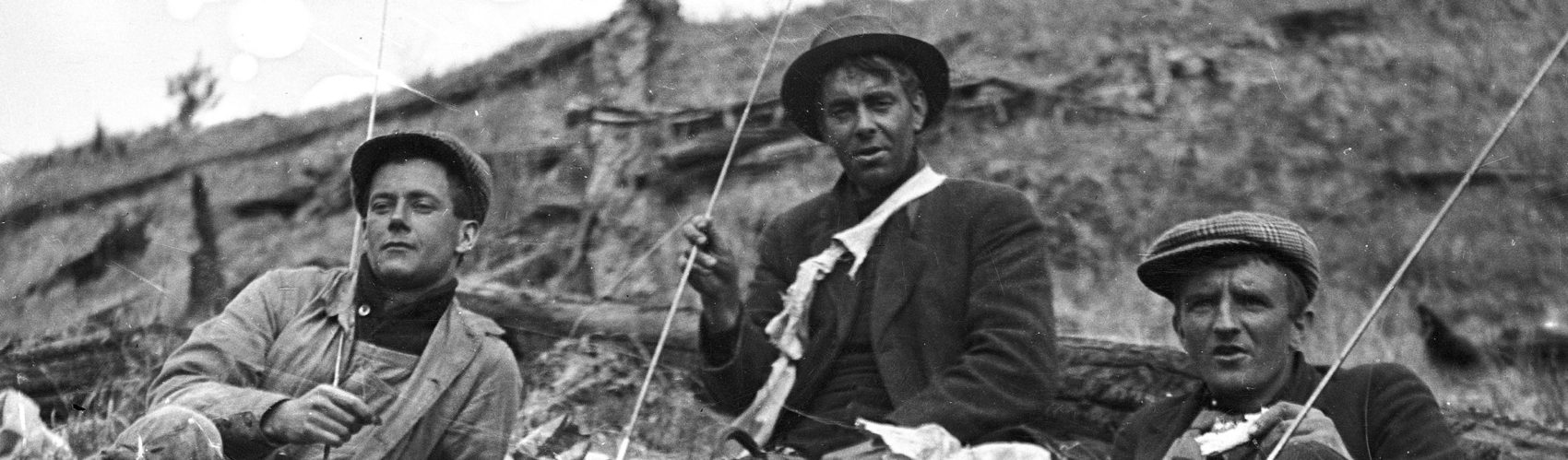
This summer Elmo had a .22 rifle. We practiced a lot with it till we could sometimes hit the nail that held the target on the board. He also taught Pepper to jump through a hoop and later through your arms. Pepper would do this till he was so old that you had to put your arms down low so he could jump through them. We took time for fun but did a lot of work. We went down to the river to swim, and Elmo was surprised to see that I could swim so well although I had not done any swimming for years. We went fishing once and caught a few small ones. He was never there during hunting season, or we would have done a lot of hunting.

Chapter 11 – Our Children

Brady was born: It was July 28, 1896, when our first child (Brady) was born. There was no milk for him and neither of our cows’ milk was fit for him, so Watie got on a horse and swam the river to get milk for him. He was so hungry that he took two bottles of milk, then went to sleep and slept like a pig.

Pine Grove School, 1897: The spring of 1897 I taught a select school of small children in the old Pine Grove meeting house. I had a fair-sized school, which paid me well. They were a bunch of bright children and did good work. One day Jennie taught, and some of the larger girls tried to scare the little children by telling them they saw a ghost. John Bee (the doctor’s boy) just said, “All magination, all magination.” I enjoyed this school very much.

Lower Bone Creek School, 1897-1899: The next two winters I taught the Lower Bone Creek School. The winter before a girl had taught it, and she had not been able to manage it at all. They would not mind her at all and annoyed her every way they could. I had no trouble and enjoyed it very much.

February 12, 1898, was the coldest time I ever saw. It was clear as could be, but the air was full of frost-that is, the moisture in the air was frozen into snowflakes. I had a black cow in a barn by herself, and she was covered with frost until she was white. We could hear the trees cracking in every direction. I had to go one-half mile to feed my sheep, milk the cows, and feed the stock, and then go to school. It was 10 a.m. when I got to school, but there was no one there. The fire builder had stock to feed by the school house; so he had built a fire, fed the stock, and gone home for his breakfast. In one-half hour one came; in an hour three more came; and at noon Rupert and Arlie came. So we had six that afternoon-all boys. It registered 44 degrees below zero. Most of the orchards in the valleys were killed. All of the beech trees half way up the hills were killed, and nearly all of the dogwoods also were killed. Nothing like this was ever seen here before nor since. That afternoon it got much warmer, and by Monday the snow was gone and it was warm and nice.

Measles Outbreak: Erlo Sutton came to the last day of school that spring with an awful cold, felt bad all day, and in the morning he had the measles. He gave them to everyone he saw that day, which was at least 75. One girl about 15 in my school died; also, an old lady in Berea. Jennie, Brady, and I had them at the same time. Erlo had no idea where he got them. The next spring the trustees asked me to close the school a day early to avoid the danger of spreading disease.

Farming Enterprises: That spring I cut the dead trees on a field for Ellsworth and raised a fine crop of corn; it was worth only 35 cents a bushel when I husked it. Some different from what it is now!

In the fall of 1898 I bought an interest in a cane mill with Dad Sutton and made molasses until late fall. The next fall we began to make molasses the 29th of August and finished the 6th of October. After that we never made so many, for people quit raising cane. I enjoyed it, but it was hard work. We would begin before daylight and work until 9 or 10 at night.

About this time I bought an interest in a reaper and binder with Ellsworth. We did a lot of work for three years. Then people began to quit raising so much wheat; and I sold my share to Uncle Sam Stalnaker.

The Stansburry School, 1899-1900: In the school year of 1899-1900 I taught on Spruce (the Stansburry School, and may I receive forgiveness for teaching in such a place). There was just one family which was interested in an education (George Brissey’s), and they were the only ones coming at the end of the term. Mr. Brissey said he always had to furnish all the scholars the last month of school.

I had 59 in school, and 19 of them were in the first grade. Of these one was a 16-year-old boy who was almost as heavy as I was One was a girl of 6 who wasn’t larger than a pound of soap after a hard day’s washing or a minute and it half gone.

The most of these first graders had no book but a speller! I told each of them to ask their parents to get them a First Reader, for I couldn’t teach little folks in the speller. The next morning I asked the children what their parents said. Some said their mother said she would get a reader that day; others said she would get one at the end of the week. The little girl before mentioned said that her mother said whenever they learned what there was to learn in the speller, she would get them a reader. I thought, “Poor kids; they will never see a reader.” Their father was working in Ohio. When he came home, he got them a reader. Think of a country school of eight grades and 19 in the first grade!

Now this little girl I wrote about had a sister 7 and a brother 8, and the girls were too mean to live. One day I was hearing a class when they got very much amused, and I asked what was the matter. One of the class told me that Flossie was spitting on Donie; so I told Flossie to go up and sit on my seat. She began to cry and said, “Donie was spitting on me, too.” I then told Donie to go up and sit there too, which tickled her for she thought she would have a lot of fun. But when I told her I would sit between them, she said, “No.” I tried to get her to sit on the bench, but she wouldn’t so I held her on my lap. She fought and kicked and tried to bite, but I just held her while she yelled, “Let me down mister; let me down.” I held her for about a quarter of an hour; then she sat on the seat all right. They did not come back, and the mother said I was holding the girls on my lap so she had to keep them at home. When the father cane home, he sent them back.

They were liars and had little idea of honor or right. I don’t think they were as much immoral as they were unmoral. They had a very low order of intelligence; in fact, they did not want to know much. I will give one instance of lying without cause or reason. A boy got mad at a boy behind him for putting his feet under his desk and said to him, “If you don’t keep back, I’ll cut your guts out.” I whipped him. A girl got excused to go home at recess (she was 14 years old) and stopped at a house on her way home and told them we had had an awful time up there that afternoon. She said that Okey Bird had taken a knife and ripped Russell Haddox right down his belly and then cut him right across. Of course, she was bound to have known they would find out she was lying, but she just wanted to tell a lie-probably to keep in practice, but I don’t think she needed any practice.

I had trouble with a McDonald who told that I had hurt one of his boys seriously. I sent him word to show up or shut up. When I saw him, he agreed to shut up. Of course, he didn’t, because that is not the nature of such people. But it did me no harm, for I still got schools without any trouble.

Harold was born-January 1, 1900. He was a very happy little fellow who endeared himself to everyone. Of course, we did not know that he would not be with us for only two short years. (If we could only know about these things, we might be so different.)

Lower White Oak School, 1900-1901: This next summer I bought the Parker place of Aunt Polly Kelley and moved over there that fall. I taught the Lower White Oak School the winter of 1900 and 1901. This was a rather long trip, but I had a very nice school. I had a very nice First Reader class of four. They each tried very hard to be the best in the class, so I told them one day that the next day I would tell them which was the best. The next day they were all excited about who would get the honor of being the best in the class. Of course, I was likely to get in bad; but just watch what I told then. I told them that the best one in the class was the one that studied the hardest. Everyone was happy, and each one studied his best to let no one in ahead of him. One has to try many things to get the best results.

Watie and Elzie Sutton (Jennie’s brothers): Watie came home from New York with Maggie this winter. They lived in Berea for a while, and Watie got a job with Fox and Meredith. The next summer he got a chance to buy Steve Bee’s farm by the Deep Ford. I got the money for him to pay for it. He stayed here until he went to work for Flanigan. From there he went to Doddridge County to an oil pumping job, which he kept till he retired. He was a hard-working, honest, truthful man who could be depended upon every time. He and I were great friends. Every time I go to Salem, I go to see Wilma, who is his only daughter and a very nice woman with a very nice family.

While I am writing about Watie, I will also write about Elzie, who was one of the finest boys one would want to see. He went to Salem when he was a young man and went to work for Uncle Lloyd Randolph about 1902. He then went to work in Uncle James’ store. He stayed there until Uncle James broke up, when he went to work as a carpenter. In the meantime he married Ethel Lynch. He was so industrious that he exposed himself by working in the rain to finish a job and took pneumonia, which ran into tuberculosis. He went to Colorado, where he lived for ten years. Ethel and two girls are still living in Boulder, Colorado. Ethel is very industrious, saving, and a fine manager. She is a loyal worker in the Seventh Day Baptist Church at Boulder. Bobbie (the third boy) died at Berea nearly fifty years ago.

Typhoid Malaria: In the summer of 1901 Jennie was very sick for several weeks, so that we had to have a hired girl. Watie and I raised a big patch of cane, and it was very fine. A good deal of the cane was down, and it rained nearly every day. We were wet nearly all the time while we stripped it. There was lots of typhoid fever in the neighborhood, and I felt sure I was taking it. So I went to the doctor and got some dope before we got the molasses made. We had 115 gallons.

Sabbath noon, after we got through, I took a chill, went to bed and sent for the doctor. He said I had typhoid malaria. As soon as the doctor said I had the fever, the girl went home. Jennie could just walk about the house a little, and Brady was five years old. John came down that evening and gave me a sponge bath. He said he would be back the next night, but the next night he had the fever. Ellsworth had always helped, but Arley and Aunt Mat each had the fever, so they couldn’t help. The neighbors were so afraid that they would not come near. A neighbor boy (Creed Collins) came and offered to go and get me a school (I had no school), but he would not come into the house. He got me the Upper White Oak School. I was glad for that friend.

Brady gave me the medicine and water, and Mama got us something to eat. I was up in two weeks. It was in late September, and I had to stay in bed for a few days as there was no wood to warm the house until Riley Davis (our pastor) came down and cut some wood. A friend in need is a friend indeed, so I have never forgotten Creed Collins and Riley Davis.

One more I must mention. Someone (I never found out who) went to one of my trustees and told him that I had got me another school. At the same time I was in bed with the fever Tom Bee was carrying the mail in that neighborhood, so they came to the post office to ask him. He told them I had the fever, but when the time came I would be there and teach them a good school. The first chance I got, I thanked him for it; I have thought more of him ever since. Jennie’s father had the fever, and I went there and waited on them. I think there is where I got it. There were over 30 cases of fever about Berea that summer and fall, and only one death.

Whooping Cough-Harold Died, Ashby was Born: I had a fairly nice school this winter. But it was a very sad winter, for Brady and Harold got the whooping cough. When I came home at the end of the week (January 17) Harold did not come to meet me. Jennie said he was sick, that she had had the doctor and that he said it was brain fever. Just one week later (the day Ashby was born) Harold died. That was a sad day for us. We kept Brady in another room in hopes Ashby would not catch the whooping cough. It worked, and Ashby did not get it.

We had a very nice girl (Edna Campbell) working for us. Brady would get lonesome as he could not go into the room where Jennie was; so Edna would take him up and sing to him. In fact, she taught him to sing.

This winter I boarded with a Baker near the school. They had five children in school. Mrs. Baker would help them in their studies every evening after supper. There were three in the same class, and the youngest was the best of the three. They treated me very well.

Middle Fork School: The next winter I taught on Middle Fork. The winter before a girl had taught who could do nothing with the children at all. When she said anything to the big girls, they would jump up, shove up their sleeves, and tell her to look at their muscles and that she couldn’t do anything with them. They took a B-B gun to school, put a mark on the blackboard and shot at it in time of school. I soon tamed them some and had a very nice school.

I fixed up a house on Elva and Dow’s farm and lived there as it was too far to go from home and there was a river to cross. This was a very pleasant winter for us although there was some deep snow and some cold weather. We were all well and happy. We kept the house good and warm, with the best hickory wood you ever saw; and we had plenty to eat. So what more could anyone want?

Friends in Ritchie County: Yes, and we had good friends near, which made it still nicer. I wonder if we ever appreciate friends as we should. We have always had friends, but I still think of the friends back in Ritchie-Mr. Haddix, Mr. Colgate, John Meredith, Mintee Fox, Mr. Wagoner, John Bee, all the Maxsons, Jack Hudkins, Mr. Kelly, Karl Bee, Art Brissey, Maynard Brissey-yes, and so many more that I can’t begin to name them all. But I must mention Uncle Frank and Uncle Herman, Reuben and Albert Brissey, Ves Collins. Yes, and I mustn’t forget Jess Kelley, with whom we used to hunt so much.

Sun Rise School-Avis was Born, October 30, 1903: The next winter I taught at the Sun Rise School. This was a long trip, so when Marshal Ehret wanted us to move into his house and feed his cattle and let me have hay for my horse, I agreed and moved up there. Before we could move, our only girl (Avis) was born. We had a very pleasant and profitable winter there.

I will tell one thing that happened at the house while I was at school. The stove pipe went up through the roof without any flue. One day when Jennie was alone with the baby, she saw that the roof was afire. The spring was a quarter of a mile from the house. She had a pan of dish water on the table and a rung ladder set against the side of the house. She grabbed the pan, climbed the roof, threw water on the fire, and put the most of it out. Then she took her hands and scraped the coals off the shingles. She burned her hands some, but she saved the house. This took lots of grit, but she did it. The baby was only a month or six weeks old.

We did not take our cows with us as there were several there. He promised to pay for the feed for the hens if they didn’t lay enough to pay. Snow came right away, and they didn’t lay enough to amount to anything; in fact, not a dozen all winter. He did not pay me anything as he said he had left some flour and meal, which he thought would pay for the hen feed. This was no pay at all, but I didn’t say anything as I expected to stay there some more because it was handy. I fed nearly 30 head of of cattle and calves. He came out and saw his stock just before school was out and was very well pleased with them. School went very well; but, as in most of the schools, some of the children would not try to learn.

Father Died, Fall 1903: The fall of 1903 Father came to Salem for Conference, where he and many others got ptomaine poison. He got better and came out to Berea. On the train he got worse and was never out of bed after he got to Ellsworth’s. We had two doctors, but they could do nothing. As the children were all there except Virgil and Cleo, they decided to settle the estate at once. There was no will nor debts, so each would share alike. Mother Randolph said she only wanted enough to keep her while she lived; if the children would give her 4 percent of their share per year, she would be satisfied. This was very generous of her, and I feel sure the children all appreciated it.

Ashby had Scarlet Fever, 1904: We went to Commencement at Salem in 1904 and left the children at their grandpa’s. When we came back, Ashby had the scarlet fever. He was very bad for two weeks. In fact, it did not look like he could live at all. He did not cry or make any noise except when we doctored him, which was every half hour; then he would make a very peculiar noise. When he began to get better, he was too cranky to live. When we gave him a drink in a cup, if he wanted it in a glass, he would throw it as hard as he could. If he wanted it in a cup and we brought it in a glass, the same thing happened-we never knew which one he wanted.

The first day I left the house I went a half mile to hoe my corn and stayed all day. When I got home, I found Jennie scared nearly to death. Aunt Sarah Colgate had been there and told her Ashby was deaf, for he wouldn’t notice when they called to him; in fact, he wouldn’t notice anything they said or did. I told her of course he would do nothing they wanted him to do. This did not convince her, so I stepped out in the dark, picked up a board, hit the side of the house; and he nearly jumped out of the cradle. This settled the question of his hearing. He did have a lot of trouble with his ears and nose that fall and later. I think this will be enough about Ashby for the present.

Ellsworth died in 1905: Ellsworth did not have his farm all paid for. He told me in the spring of 1904 that he could pay out by selling his stock. He was killed in the spring of 1905 logging for Zeke Bee. This changed many things for me, as we had always worked together. I would help him when he needed help, and he would help me.  When Blondie was a very sick baby, we went night after night and sat up with him. Then when Ashby had scarlet fever, they came for two weeks and sat up with him. As I said before, “Never did any one have a better brother”. It was during this winter that Ashby was so very sick that he would not notice anything. We were alone for two or three days, but Ellsworth came up as soon as they heard of it and stayed all night. It was this night that he really began to improve. When something did not suit him, he cried for the first time he had made any noise for three days. Never was there a brother that stood by better than Ellsworth.

Middle Fork School: That winter I taught again at Middle Fork. A young man had taught the winter before. He had paid attention to Ada Knight, which had made the Zinn girls very angry. When school began, I found that I had a job on my hands. If I smiled at the Zinn girls, the Knight girl wanted to kill me; if I smiled at the Knight girl, the Zinn girls would try to kill me. They would not sit near each other at class. In two months they decided that Zinns and Knights were all the same to me; so we got along all okay.

One boy gave me a lot of trouble the first winter. He was easily influenced, and a big boy and girl put him up to mischief. But the second winter I got him interested. He studied hard and decided to go on to Salem, which he did and got a good education. I am always very glad when I can get a boy or girl interested in going ahead to school. I feel the school a failure if no one is inspired to go ahead along the road toward education. Every teacher should be able to fill his pupils with such a thirst for knowledge that they will never be satisfied until they have drunk deep of that fountain. I am proud of the fact that I have inspired many to go on in their studies. I am especially proud of the fact that, where no one had ever gotten a diploma from the eighth grade in one school in Braxton County, now more than a dozen have finished high school. I am proud because I know that I was directly responsible-but more of this later.

My First State Teaching Certificate, 1905: My certificate expired in 1905, and I did not try for a school. In July Mr. Mason sent me word to come up and get the Sun Rise School. He said that Port Campbell was wanting the school but that the district did not want him. Mr. Mason, Mr. Hayden, and Mr. Campbell were the trustees. Mr. Campbell could not help hire Port, so he resigned and tried to get someone else appointed who would help Mr. Hayden hire Port. Mr. Hayden said he would be glad to sign my contract. I went up to see Mr. Mason and then to Mr. Hayden. We ran him down, and he squirmed like possessed. At last he said that I could have the school, so I got a certificate. This was my first state certificate.

When Port heard I got the school, he said I could not get a certificate for I couldn’t get anything on “Grammar.” He got 65 percent on grammar, and I got 93 percent. He said the grammar didn’t suit him. It sure didn’t. Since that time Port and I have been good friends.

In spite of all handicaps, I had a fairly nice school; indeed, it was above the average, so I think.

Working in New York for Gene Jordan

Randal was Born: On February 3, 1906, our fourth son (Randal) was born. He was a delicate baby; soon after we got to New York he had a serious case of pneumonia. We were lucky to get a very fine doctor for children (Dr. Loughbead), who fixed a formula for feeding him, and he did much better on it. He was a Seventh Day Baptist at Nile, and we were very lucky that we got him.

We sold some of our household goods and left some. Very little of what we left was to be found when we got back. We took some bedding with us, but little else. The weather was fine, and we had a very nice trip. A livery man took us from Cuba (seven miles) to Gene’s. We stayed there for over a month before they could get our house ready. We had a fairly comfortable house to live in. We put in several potatoes and some corn. Gene drilled a gas well near our house, but it was not much good. Soon after this, he got a contract to drill several wells in Pennsylvania. The boys went down there with him.

He bought a new horse and came up to start harvest. When he tried to work the horse, it proved to be an awful kicker. He went back and told me to work her and they would come back and help me put the hay up when I got a lot of it cut down. They came back and put up 35 acres. He had 30 acres he wanted to get put up on the shares. I told him Brady and I could put it up (Brady was nearly 10 years old). We put the 30 acres up, for which I think Brady got about $7. This wasn’t much, but it was dear gain, and it paid Gene very well.

In the early fall Gene’s family went down to Pennsylvania. We spent the winter in their home so we would have a warmer house and be closer to the feeding and milking. We had a fine lot of winter apples. I had so much work to do and no help that I only got a start when 8 inches of snow came (the 8th of October). It only lasted a day or two, when I went on with the picking. Before I got them picked, we had hard freezing. I would just wait till they thawed out and go on picking. I finally got them all in the cellar, and we had apples till after the middle of July. Two years later the tenant did not get the apples picked till after a freeze and lost them all.

The first summer we were there, Brady caught 25 woodchucks. He would hide near their den, wait till they got away from it, then beat them to it and get them. There are a great many woodchucks in New York.

Brady had a lot of trouble in school. Some of the larger boys would beat up on him, and the teacher would just laugh at him. I, or we, got tired of this (he was having a headache all the time) and took him out of school. The teacher reported him, and the truant officer came. I was prepared for trouble, but he said that the former teacher, who lived in the district, told him the way Brady was treated and said she would not send him a day. A neighbor told him it was a shame the way he was treated and that the trustee said he told one of the boys to let Brady alone, but the boy said he would do as he pleased and he couldn’t help it. The teacher denied this, but the officer told her if she wouldn’t take care of the children he wouldn’t make them come. So he said he would get his stepson, who was a doctor, to give him an excuse. The teacher tried again, but the officer paid no attention. He told her he didn’t do his work twice.

Trading a Kicking Horse: I spoke of a horse that could kick. We called her Maud, and she could kick! She took it by spells. Sometimes she would work for several days without kicking any; then she would kick things all to pieces for a few days. Oh, she was a honey! I saw a man in Nile who wanted to trade for her. I told him she would kick some but that I had worked her at everything I tried but one and that was plowing. He wanted to know what she did. I told him she kicked, ran back, acted the fool, and did everything but plow but if we didn’t trade, I would plow her. We traded even, and he had new shoes put on the horse I got. The blacksmith where we traded told me that the man I traded with said he wouldn’t take less than $125 for her. There was a number by, and he thought he would have some fun at my expense. I just looked at him and said if she had suited me I would not have taken less than that, but she did not suit me so I let her go. The crowd roared. I never saw the man I traded with again, but I learned he was a regular horse trader so I presume he came out all right. The horse I got was a fine worker but very slow, so I came out all right, thank goodness,

Ashby and Avis: The first summer we were at Gene’s, Ashby and Avis went with me up there (Ashby was 4 and Avis was 2). When I got the team ready to go to work, I told them to run on home, which was one-fourth mile away. It was thundering, and they were afraid; so Cleo went along. Avis said, “We’s too good for thunder to hurt us, ain’t we, Auntie?” They were very good just then.

This next story was told by a doctor. He asked Cleo about her little children. She said she had no little children; they were all grown up. Then he told her that he was going by there the year before when he saw two little children playing in a swamp and he said to them, “What are you doing, little children?” The boy said, “We are catching bullfrogs.” Then the little girl piped up, “You mustn’t say that, Ippie; you must say cow frog.” Cleo knew who they were, for Avis always said “Ippie.”

Ashby had a lot of trouble with a gobbler that Cleo had. He could make it too much for Ashby. Gene had a collie pup he called Romulus which thought a lot of Ashby. Whenever the turkey would see Ashby, he would jump on him, and Ashby would say, “Come on here, Romulus, he’s coming.” Romulus would right off and run the turkey away. As soon as the turkey saw the dog was gone, back he would come; and the same talk would happen again, “Come on back here; he is coming again.” He never called for any of us to help, and the dog always ran the turkey away.

Back to West Virginia, Fall 1907

It was not a very successful year. The cows Gene bought did not prove to be fresh in the spring, as the man he bought them of said they would. We did not get much milk (which is the chief money crop in that neighborhood). Jennie was sick most of the summer and fall, and things did not look good for the future. Therefore we decided to come back to West Virginia, which we did in the fall of 1907. I sold the team and some other stuff to the renter Gene got to take our place. Gene took the man’s note for the team. For the rest of the things I got some money, a cheap railroad ticket, and a little surplus which he promised to send-but of course he never did. On the whole I made a good deal with the man, so I never worried about the unpaid balance.

Coon Hunting before We Left New York: The renter said he had a good coon dog, so Gene and the boys and I went out before we left. We got a coon in a little while, and later we treed another in a slump of trees. We decided to watch it. As it began to get daylight, we decided the coon had gotten away, so we started home. But the dog struck a track right away and in a few moments treed. Gene said he saw one and shot it out. I told him to let me have the gun, and I shot another one. This made us three coons in one night, which we thought was quite good.

We stayed in a hotel the first night in Pittsburgh. The next evening Elva met us at Pennsboro with a wagon. We lived in a house on Uncle Elisha’s farm, where he had lived for many years. I taught the Upper Otter Slide school. This was a very pleasant school with one exception. Tom Gribble got mad at me about his son Paulie and took him out of school. He raised a fuss about my being partial toward my children. I called the trustees in and demanded a hearing. They failed to get Tom to come, so they came in and told the school that there was nothing to what he was telling so I let it go. The trustees were Al Kelley, Tom Ward, and I’ve forgotten the other one. Tom Gribble objected to Ashby’s going as he wasn’t quite 6 (Tom sent his children before they were 5, and Ashby was there once).

More about Ashby and Avis: As I have already said, Ashby did not go to school the latter part of December and until January 24. One cold day Jennie got to wondering what the two were doing. She found them playing meeting. Ashby was the leader, and he told Avis to get up and speak. She said, “I don’t know what to say.” He told her to get up and say, “The Lord has gone from me, and the crows are carrying my chickens away.” How quickly children can learn to imitate older people!

Avis was very successful in getting her way with children, but Ashby had a fine way to get her to do as he wanted her to. He would say, “Avis, if you don’t do this, I won’t watch the snakes off of you.” She would always say, “I’ll do it, Ippie, if you’ll watch the snakes off of me.” She feared snakes very much and was certain that Ashby could keep them off of her. Children are so trusting, but they soon learn to doubt us for we fail to do as we say exactly all the time.

Randal Died: We were to move into Pa Sutton’s house in Berea as soon as school was out. Aunt Rachel had not moved out yet, so we had to wait a few days. I was working for Dow and had just gotten back to work after dinner when we heard Jennie calling that Randal (our baby of two years) was dying. She had carried him for about one-half mile. He was dead. Jennie thought he had choked to death, but he hadn’t. He had taken some kind of fit or spasm and died without a struggle. Had he choked, he would have struggled for breath and his face would have turned black, none of which happened. He had never been strong. We were glad he went without suffering rather than being sick and suffering for weeks. It was a terrible blow to us, especially to Jennie. Although she did not talk much about it, I doubt if she really got over it until after the birth of Elmo. Even now it is a sad thing to write about, so I will write no more about it.

A Big Bass: We moved to Berea and raised a garden down at the Polly Place as well as in Berea. One day Brady and I were down there working in the garden when Brady got tired and wanted to go down to the river. He said he heard a big fish on the riffle. I told him to go on as he had worked very well, and I thought he was tired. As soon as he got down there, he began to holler, “Come down here quick! There’s a big fish here.” I knew there was no big fish that we could catch, but I went to please the kid. When I got there, what do you suppose I found-a bass one-half as long as your arm in a hole of water 10 feet long, 3 feet wide, and 6 inches deep, with very shallow water on each side.

I told Brady to drive him up to the upper end where I had put a cross tie so he couldn’t get away, and I would kill him with a club. I didn’t think he would go below, but he seemed to be afraid of me and only came part way. All at once he went by Brady on the dead run. I yelled at him, “Now you let him get away.” The water was so shallow that he had to turn on his side and flop. Brady rushed for it and hit it on the head with all his might. That was the end of the bass! It was 18 3/4 inches and weighed 3 lbs. 14 oz. and made more than we could all eat in a meal.

A Home in Berea; Lower Room at Berea School: That fall I sold the Polly Place and bought the house and lots where we lived in Berea. I got the lower room to teach at Berea, and Ernest Campbell was principal. I did not ask for a place at Berea. When the one they gave the lower room to would not teach, I got it and had a very nice time. I had to teach the first five grades as Ernest would only teach three. He would not try to keep his boys from running over those in my room. One day at noon my room and some of the upper room were playing trim a Christmas tree when Orin Hammond came down and began to tear it up. Then Hose Brake made for him, and they had a time. Orin never bothered my kids again.

I had a bunch of girls from 8 to 10 who were said to be so badly spoiled that they could hardly be controlled. I found them as good students and as nice to get along with as one could ask. They were Guerney Brake, Jessie Hayhurst, May Douglas, Darla Bee and some others. They would do anything I wanted them to do. They each wanted to do more than the others. This winter Guerney Brake came to school the first day with the mumps. We all had them but me, and I still have not had them. Brady had them very hard, for he took a backset on them.

Auburn School, 1909: The summer of 1909 I taught a school for advanced scholars in Auburn. I had a large school, which paid me quite well. I had 40 students. I did so well with the lower room that they gave me the principal’s place the next winter. This was a much harder job, but I got along fairly well. I got the ill will of Tom Jackson and Ell Douglas, which caused me a considerable trouble.

The Grange: About 1908 they organized a Grange, which did a lot of good for a few years. Two years we had a Farmers’ Institute with fine speakers from other parts of the state. This was very fine. Then for two falls we had a Farmers’ Picnic with fine speakers. The fall of 1912 we had five or six of the best speakers in Ritchie and one (a very able speaker) from another section. There were hundreds of people there, and it was a very successful affair. I was lecturer and had charge of the program, and I think I had a small part in its success. We tried to start a Grange store. We bought a suitable building and lumber to fix it up, but we failed to find a manager. We sold the property, lumber and all so that we did not lose anything. Mr. Wagoner moved away, we went to Salem, and the Grange died.

Building onto our Home: After finishing my school at Auburn, I decided to add another story to my house as it was a one-story house. I took some of the ceiling and upper floor from the Polly House, which I still owned. This was red oak and hard maple, very fine, tongued and grooved. I also bought some fine dressed lumber at a sale very cheap. This way I was able to have a good two-story house.

Chapter 7 – Mother Died, Father Remarried

I will now go back and take up some events in my early life which changed all our lives. Mother went to church on Thanksgiving in 1887 and took sick that night. There was no doctor near, nor telephone, so a man went to Harrisville and got Dr. Hall. He said it was typhoid fever. With all the care we could give her, she only lived a week. We sent a telegram to Virgil, who was in New York. It was delayed, so he got to the church after the sermon was partly over. He stayed a week, and Father went back with him and stayed for a short time. This was the only time Virgil has been in West Virginia since he went to New York in 1882.

Cleo and Emza kept house for nearly a year. Then Emza got married, and Cleo did the work herself. This was very hard as we would have eight or ten hands in harvest. She would get up at 4 a.m., get breakfast, prepare dinner, and fix supper and take it a half mile on the hill to the hands for a five o’clock supper. Hands began at sunrise and worked till sunset then. Cleo had never been very strong, so this was too hard for her; but she never complained. In the fall of 1889 Cleo went to school in Salem, and Aunt Delilah (Father’s sister) stayed with us. Then the next year Cleo went to Alva’s at Alfred and never stayed with us any more.

We kept bach, but Father was very restless and was away a lot, leaving Delvia and me to care for ourselves-which we both enjoyed. In the spring of 1891 Father went up to Alfred to get married. He stayed for about two months. We kept house, did the work, and put in the crop. Someone told Father that Ellsworth said he had lost $500 by being gone. He never said any such a thing, he told Father when he asked about it; for he thought we got along better while Father was gone than we all three did when he was there. I doubt if Father liked that very well.

Gigging: It was while Father was gone that we asked Elva and Dow down to go gigging with us one night, as we found gigging was quite good that spring and there was no fishing on the head of Otter Slide. We split up poplar rails into small long pieces, which we tied into long fagots. We tied these up with leather bark (the bark of a small bush which peels well early in the spring, and is quite tough). These fagots are from 6 to 8 feet long, make a fine light, and burn for a considerable time. We started out as soon as it was dark. We soon found there were fish on the riffles. I carried the torch, and Elva carried the fish in a sack pouch over his shoulder. At first I had the heaviest load; but by the time we got to the bridge, the sack was heavy. In some places we saw ten fish for every one we got, but we got plenty.

Just as we got under the bridge Elva exclaimed, ”Look there.” I did, and there was a bass! It looked as if its back was out of the water although the water was over a foot deep. I told Elva to hold the torch, for I feared he would fail to get it as he had never gigged before and a bass is hard to hold. I hit that bass as if I meant to kill a bear. I hit it at the gills, and it was so deep through that it turned on its side and cut its spinal cord; and it never flopped. It was over 18 inches long. Oh, it was a dandy! When we got home, we had about a bushel of fish. Elva and Dow surely did have a great time, and I was so glad for they were the best friends we had for many years.

How I wish that Elva, Dow, Delvia and I could be together to fish, hunt and roam around over our old playgrounds! But alas, Dow is gone; Elva is not able to do anything; I am a wreck; and Delvia is far away. So we can never all meet here again. But I hope we may meet again in the future when the troubles of this life are over.

Father Returns with New Wife, Then Moves to New York: When Father was to come home, Ellsworth and Sarah went after them in the road wagon. They had to go to Pennsboro (14 miles), where they left the train. As we had a sheep to shear at John’s, we went over there to shear it in the afternoon. Just as we got back, Ellsworth drove up with the folks. Father said we would have been more presentable if we had been dressed up, but we told him we had been shearing sheep. That evening he told me I would have been more presentable if I had on collar and cuffs. Now I had asked Father to get me them before he left, and he said he never had anything of that kind when he was a boy. On Sabbath he said the same thing again, and I told him what had been said in the spring.

Delvia and I did not get along extra well with Mother Randolph, but both sides were to blame. But we never had any real trouble.

That fall I was 19 and taught my first school at Lower Otter Slide. I expected to hate teaching, but I enjoyed it so much that I decided to make it my life work.

That winter a letter came to Mother Randolph from her sister that she was very sick (she was a dope fiend) and wanted her to come at once. She went and did not return, so Father went and took Delvia with him in the spring of 1892. He offered to send me to school until I could get a first grade certificate if I would go with him. I did not go for several reasons. I got a First Grade that fall, so it would not have helped me much. I did not like Alfred, and still don’t. I had become interested in a girl (not girls), so I stayed in West Virginia. Had I gone, my whole life would have been changed and that of my family. I still am glad I did not go; knowing my disposition, I would never have been happy there.

Some Changes I Have Seen

I will now tell you of some of the changes that I can remember. The first buggy was owned by Jonathan Lowther. I was 8 or 10 years old when he got it. Mr. Brake got the second, which was the first with a top as the first one was a buckboard. Father got the third buggy. It had a top, and he sold it after Mother’s death. Mr. Brake bought the first mowing machine about 1884; Father bought one about 1887 or 1888. Father had a turnover rake made about 1885. This was about 8 feet long, so you could rake an 8-foot strip. It was pulled by a horse while you walked behind and tripped it whenever you wanted to make a windrow.

In 1892 I had never seen an auto, an airplane, a radio (in fact, none of these existed at this time), a reaper and binder nor a telephone. I had never ridden on a train nor seen a streetcar, had never heard of a refrigerator, nor seen a washing machine. We had no solid roads; for about four months out of the year the mud was so deep that a wagon could hardly get through. There were no electric lights in our section (we made candles sometimes), and all heating was done with coal or wood stoves. We knew nothing about electric milkers, bathroom fixtures, nor sweepers. Oh, things were different then! What would we do now without typewriters, adding machines, and so many other inventions that we never stop to think of?

Much to Be Thankful For

I will say right here that life has been good to me. I have had many good friends; my wife and I have lived together for over 55 years; our children have been good to us; we have enough to live on fairly well. Yes, and we still have fairly good health-so what more can we ask?

Chapter 2 – My Early Childhood

I was born on the Right Bank of the South Fork of the Hughes River on September 7, 1872. The old homestead was about one mile below Berea, which at that time was frequently called “Seven Day Town.” I have no specific memory of the event, but I presume I was about as unpromising a brat as could be found in seven counties, for my first memories which I can recall make me think I must have been “small potatoes.”

Falling in a Lime Vat at the Tan Yard: At an early age (probably two or three, for I had on my first pair of pants) I wandered up to the tan yard, which was about 150 yards away. Among other attractions was a lime vat-this was a wooden box 6 by 4 feet, set 4 feet in the ground and was nearly full of water in which had been poured enough lime to take the hair off the hide (or a little boy)-and I proceeded to walk right into it. Luckily there were some hides in it, so I did not go over my head.

Ellsworth, who was ten years older than I, ran up, grabbed me by the hair and pulled me out. Father came running out of the shop with a leather apron on, which he always wore when he worked in the shop, and yelled, “Take him to the run; take him to the run!” There was a hole of water in the run about ten steps away; Ellsworth ran down there, threw me in and rolled me over and over. Providence seems to care for children, as well as fools, so the lime water did not get into my eyes.

There were no other bad effects except I got my new pants wet. (It was the first time I had worn them.) I had no others, so they put a dress on me. Doctor Hall, who had been our family physician for many years, came to see mother that night and made fun of me, calling me a “girl.” All is well that ends well, and I never fell into a vat again.

A Flood: In 1875 or 1876 we had a great flood. The water ran knee deep back of the house. I remember two things about this flood. It was in the night, and we felt the house shake and heard a great noise, which scared us. Upon investigation it was found that the rain had loosened a large stone on top of the chimney, and it had rolled down the roof and fallen onto the ground. The river went down very rapidly. In the morning one of the boys went out in the garden and found three or four nice big fish in a puddle of water. As I remember, they were some 12 or 15 inches long. I presume I helped eat them, but I have no memory of that.

A Deer and Dogs: In the early winter of 1876 I saw my first and only deer until after I was grown; in fact, it was the only wild deer I ever saw in Ritchie County. One morning a neighbor came rushing into the house to get the rifle. He said there was a deer out there. A hound had run it into the field, but the deer was tired of being chased so it turned and chased the hound out of the field and home.

We had two big dogs, one of which was a large greyhound that had caught a deer before. The dog caught the deer as it passed, but his teeth were so poor he could not hold it, so the deer just knocked him over and went on. This made Pete (the other dog) mad, for they were chums. He did not intend to have his friend picked on by any low down sinner while he was around. Now Pete was round and fat and never had been able to run much. It so happened that mother was having a quilting that day, and all the women ran out and yelled with all their might (which was plenty). Pete went wild.

That was some race! I stood behind the house and watched it. The deer was making great leaps (it seems to me every leap carried it ten feet) while Pete was running with his feet more stretched out, his belly close to the ground like Satan was after him. I can see it all as plain as if it were yesterday. The deer had 75 yards start when Pete started after it, and it had one150 yards to the road. Just as the deer’s tail went over the fence Pete’s nose went up.

Father was crippled so he could not go fast, so he told some of the men to hurry up there; for he knew they would meet on the ice (which was just strong enough to hold them up). One of then would surely die, as Pete feared nothing and a deer is very dangerous with its horns. Before the men could reach the scene, we heard the deer bawl (I can still seem to hear it). Emza was the first to arrive there and saw the two meet. She said Pete’s nose was at the deer’s shoulder when it turned to hook him. He grabbed it by the nose, ran between its front legs, and threw it on its back. When Uncle Elisha got there, he was chewing at its throat. Father sold the deer to a Prunty, but kept the heart and liver, so I got to taste it. Since then I have eaten venison several times, but none that I killed.

About noon the owner of the hound came and demanded pay for the deer. Father paid him although he had no right whatever to it. Father would rather give him the money than to racket with him. His name was McDonald, and the worst trouble I ever had in school teaching was two McDonalds (one in Ritchie and one in Taylor County). I would still be afraid to have dealings with a McDonald.

My First Farming Enterprise-Chickens: I will now record my first memory of farming. When about three years old, I went into the chicken business. I have heard Father and Mother tell about it many times, and I also remember it myself; so I know it’s no fake. This is the way they told it-I would run around with my pants down and a hen under each arm. I would take a hen to a box, fix a nest, put the hen on it, and make her stay there till she laid. By the time I was four or five years old, we could take a hen, put her on a nest anywhere we wanted to (if she was a setting hen), and she would sit there without being covered up. This sounds big, but it is true. I can still see myself, about as big as a bull frog, running around with a hen under each arm, with a dirty face and hands and a smile on my face, for I thought I was of some use in the world.

When I was about ten years old, our chickens got the cholera. When it stopped, we had one hen left out of about one hundred. She was a pure white hen and a pet which a neighbor woman (Ora Bee’s mother) had given me. We never had such a tame flock of chickens again as I had to work some after this.

A Fall into the River: The first day I went to school was a very rainy one. I was wearing a cloak. We had to cross the river on a foot log. Virgil was afraid Cleo or I might fall off the log, which was floating on the water. Just as he got Cleo over, he heard a splash and turned around to see me floating serenely down the river with my head up out of the water. The cloak had spread out on the water and held me out of it from my shoulders up. Virgil had told me to wait till he came back for me. Nevertheless he rushed back to the center of the river, jumped in, overtook me and landed me about 150 yards down the river.

Thus I had been twice saved from the water-once from drowning in the river and at least from the loss of my eyes in the lime vat. (If Ellsworth had not been so prompt in snatching me out of the vat, I would have been down, the water would have gotten into my eyes, and I would have never seen again.) So I owe much to my older brothers.

Anecdotes about Delvia: Probably it would be well to tell a couple or three anecdotes about my baby brother Delvia. We burned coal in an open grate. He loved to come in from outdoors and back up to the grate to warm his back. One day he came in, backed up to the grate, and stood there until someone called to him, “Delvia, you’re burning.” He moved very quickly, but not quickly enough to save losing the seat of his pants. Luckily the fire did not go much deeper.

Still Delvia would back up to things (which is never safe, for you cannot see what is behind you). One day he came into the kitchen, backed up to a chair, sat down, and wished he hadn’t. In that chair was a pan with 10 or 12 dozen eggs, which were on his seat in the form of scrambled eggs.

Fishing in Alaska

I have many happy memories of fishing as a boy, and like to to this day. My grandfather, Ashby Fitz Randolph, loved to fish. He took us to Buffalo Lake outside Clarksburg, WV. We mostly caught sunfish, and one day I caught a beautiful 19 3/4″ channel catfish there. What a thrill it was for a young man to catch such a fish!

I fished in farm ponds around Almond, NY, as well as the Canacadea Creek (before the flood of ‘72) and Fosters Lake.

Now I enjoy a 1/2 acre pond stocked with bluegills, crappie, bass, catfish and perch.

Highlights of my fishing life have included two fishing trips with the help of Larry and Ethyl Schoenborn of Fishing With Larry. The first trip was in 1998 to Whalers’ Cove Lodge in Angoon, Alaska on Admiralty Island. It was a week-long trip of King Salmon, Silver Salmon and Halibut fishing. A hilight was canoeing into the interior of the island and stream fishing for silvers on light spinning outfits. The eagles and bear were majestic.

The second adventure with Larry and Ethel was in 2002 to Komaham Lodge on the Skeena River in Terrace, British Columbia, Canada (You Bet’cha!). My mother, her husband, sister, brother-in-law and brother joined the adventure. We fished various rivers and saw scenery that was breathtaking. We used jet boats as well as drift boats. Some guests took a helicopter to some of the best steelhead rivers in the world. One day I went ocean fishing for silvers and halibut. What an adventure!

My hope is to go to Alaska again, this time to Kodiak Sportsman’s Lodge on Kodiak Island. Larry says it is the best saltwater King Salmon fishing in Alaska.

Appendix B — Descendants of Ashby F. Randolph and Ruth Content Bond Randolph

Synopsis of Lives of Sons and Daughters


Ashby Bond Randolph

Bond graduated from Bristol High School in May 1944. He had begun his freshman year at Salem College before his 18th birthday, so he got a deferment from military service until he completed that year of college.

Bond was drafted into the U.S. Army in July of 1945, and he married Ruby Oldaker on December 24, 1945, on his first leave from the service. He was sent overseas to Germany; then returned and was discharged in January of 1947. Ruby continued her previous employment at the Weston Glass Plant until April of 1947, when Bond obtained his first job.

Bond’s first job was as a truck driver on a strip mining coal operation in Weston at $1 an hour; he then became oiler on a shovel for the same company at $1.20 an hour. He became a bulldozer operator in August of 1949 and earned $1.70 an hour. By this time, they had three sons and Bond’s work was not always steady; but Ruby did not work outside the home.

In August of 1950 Ruby asked Bond to return to college on the GI Bill so they could have a better future for their family. He did return to college and graduated from Salem College on May 29, 1952.

With a college degree he found work as a janitor for the Hope Natural Gas Company at $7.49 per day. He did not enjoy this inside work and quit the company in March of 1953. He sold hospital insurance for a company for about three -months, and one policy he sold was to the son of a superintendent for the Hope Natural Gas Company. The superintendent was so impressed with Bond that he offered him a position with the company again as a field worker. Bond accepted and he worked as a casual laborer for the company until December 1954, when he was hired as a regular employee. He was promoted to Utility A classification in April of 1957 and chosen as a Trainee in Safety on May 1, 1958.

Bond became a Safety Engineer November 1, 1958, and was promoted to Safety Director for the company on July 1, 1960. From this time his work was in the administrative offices in Clarksburg, W.Va. The company merged with another company and became known a s Consolidated Gas Supply Corporation; and Bond was named Manager of Safety on March 1, 1965, the position he still holds today. The company recently reorganized and is now known as Consolidated Gas Transmission Corporation.

Bond and Ruby have four sons. Because he has always worked long hours and frequently been away from home, he did not want Ruby to work outside the home. She has been a life-long homemaker, a position she has always enjoyed. She likes to call herself a “Domestic Engineer.” She has done quite a bit of volunteer work; at one time she worked one day per week as a volunteer at the local Veterans Administration Hospital for a period of five years.


Xenia Lee Randolph Wheeler

Xenia Lee graduated from Bristol High School in 1945. She and Edgar were married that summer. Edgar graduated from Salem College in 1947. They, with their new daughter, Annita Marie, spent the summer in Florida working with Pastor Elizabeth Randolph holding two-week Bible Schools and evangelistic meetings in Palatka, Carraway, and Florahome, Florida. That fall the family moved to Plainfield, N.J., where Edgar got his college debts paid off by working as linotype operator at the Seventh Day Baptist Publishing House.

In April of 1948 Edgar began his first full-time pastorate at the Seventh Day Baptist Church in Hammond, La., while he attended seminary at New Orleans Baptist Theological Seminary. Edgar has served churches in Louisiana; Athens and Paint Rock, Alabama; DeRuyter, New York; Salemville, Pa.; Ashaway, R.I.; Denver, Col.; and Nortonville, Kans.

Xenia Lee enjoyed being homemaker, wife, mother, and grandmother, supplementing Edgar’s income at home as she typed, sewed, or babysat.


Alois Edmund Randolph

Alois graduated from Bristol High School in 1947. He served in the U.S. Army during the Korean War, 1951-1953. He was in the 4th Signal Battalion of the 10th Corps and served in Korea.

After his discharge from the Army, Louie attended Salem College three years. Then he went to Columbus, Ohio, where he worked first at Lattimer-Stevens (a factory -making gauges) and then at Buckeye Steel. Then he worked at Westinghouse for 14 years, 12 of those as foreman. While he was still working at Westinghouse, he worked during vacations and other times driving truck and moving furniture. Since he quit at Westinghouse, he has been driving trucks and doing some office work for Harvey Pugh Trucking Company.

Louie married Mary Ann Young soon after he went to Columbus, and they have lived in that area since then. They lived two years in Columbus, four years in Shadeville, and for the past 23 years in Grove City. They have two daughters and three sons.


Elsie Mae Randolph Lewis Bottoms

Mae graduated from Bristol High School in 1948 and from Salem College with a degree in Secretarial Education in May 1951. That spring she married Harry Vernon Lewis, who was a freshman at Salem. Harry had spent four years in the Navy in World War II and had driven truck across country for one year before he came to college.

After Mae graduated, she and Harry moved to Carbondale, Illinois. Harry graduated from Southern Illinois University with a Bachelors in Elementary Education and a Masters in Education Administration. While he was in school, Mae worked a year as secretary in the Government Department at SIU. Harry taught junior high at Edwardsville, was principal and taught eighth grade at Percy, was principal of the Greenup Elementary School for four years, and then was principal of Cumberland High School one year when he died suddenly in April 1961.

After Harry died, Mae completed a Masters degree in Business Education at Southern Illinois University. She taught for two years at Johnston City High School in Illinois. In 1965 she moved to Almond, N.Y., and has taught in the Executive Secretarial Department at SUNY Agricultural and Technical College at Alfred for the past 19 years. For five years she was chairperson of the Executive Secretarial Dept., from 1974-1979.

In 1979, Mae married George Daniel Bottoms. He had just retired from a career in park work in the Chicago area. He had been superintendent of engineering for the DuPage County Forest Preserve. As such, he had done much work in the development of park grounds and facilities.

George and Mae bought a home with 4 1/2 acres at Phillips Creek, N.Y. (about six miles from Alfred). Here George has spent many hours growing beautiful flowers and marvelous vegetables, making improvements in their home and grounds, and fishing.


Edna Ruth Randolph Richards

Edna Ruth graduated from Bristol High School in 1950 and attended Salem College for two years. At the end of her sophomore year, she married Donald Richards, who graduated from Salem that year. He was in ministerial training, and they moved to Alfred, N.Y., where he attended Alfred Univ. School of Theology and graduated in 1955.

Don (with Edna Ruth as a helpmate) has served pastorates in Berea, W.Va.; Dodge Center, Minn.; Verona, N.Y.; and Marlboro, N.J. While they were in Verona, Edna Ruth cared for two mentally handicapped children who were placed by the State–Tina and Kathy. They had to leave these children when they left New York State, but Edna Ruth did not leave her interest in helping children with special needs.

Soon after they moved to New Jersey, Edna Ruth began working at Evanoff Guidance Center, where she worked with retarded children in preschool. She completed her degree in special education at Glassboro State College in 1976. Soon after completing her degree, she began working for the Shiloh School District, teaching special educa

tion for older children. She also was certified as a family trainer and worked with the families as well as the children. About Christmas time, 1978, when she went to the hospital for gallbladder surgery, she found that she had cancer in the liver. After trying various treatments unsuccessfully, Edna Ruth died at her home on January 2, 1980.


Rex Main Randolph

Rex graduated from Bristol High School in 1952. He attended Salem College one semester; then he married a neighbor girl, Phyllis McClain, the following spring. They have lived within a mile of both his and her parents most of the time since their marriage. In 1959 Rex built a new home on property between the McClains and Dad and Mom Randolph. Phyllis cared for her parents during their last years when they were not well. Both she and Rex have also done much to look after the needs of Mom and Dad Randolph over the years.

Rex has worked at several jobs in the Clarksburg area. He worked for Montana Lumber Company (making pallets) for one year. In 1954 he began work at Pittsburgh Plate. He worked in the tank department in shipping for three years, as a clerk for two years, and then in the machine shop. Pittsburgh Plate changed its name to TPG Industries and closed its Clarksburg branch in 1974. Rex was offered the opportunity to move with the company, but he declined. After 20 years with the company, Rex had lost all benefits and was out of work.

Since that time, Rex has worked as layout man for General Machines in Clarksburg. Phyllis has worked at various times caring for sick people in their homes.

Rex and Phyllis are both active in the Lost Creek Seventh Day Baptist Church, where Rex is a Deacon.


Cleo Elizabeth Randolph Boyd

Beth graduated from Bristol High School in 1956. She attended Salem College for two years. The following summer was spent in service to the S.D.B. Women’s Board, working in Bible Schools and camps. On Aug. 4, 1958, she married Joe Boyd, and they set up housekeeping in Salemville, Pa.

Joe drove tractor trailer truck for a little while and then went to help his dad on the farm. When his dad quit farming, he went back to driving truck. A back injury caused a change in occupation again. This time he went to work as custodian at a local grade school.

During this time Beth came to the conclusion it was time she get into the money-making act if they were to successfully raise four children. Since her children were top priority in her life, she decided to get into the school system as teacher aide. From there, she began taking college courses and substituting in the grade schools.

Finally, in 1973 she went back to Salem College and graduated with a Bachelor’s degree in Elementary Education. She has been teaching in the Northern Bedford County Schools ever since, except for a year and a half, which was spent with their new baby and caring for her while her hip was being rebuilt.

Joe tired of being a custodian in just a few years and went back to driving an 18-wheeler. He has worked for Smith Trucking in Roaring Spring now since 1972.

Beth and Joe are both members of the diaconate of the Bell Seventh Day Baptist Church at Salemville, Pennsylvania.

Appendix A — Memories from Family Members

The following memories were collected from brothers and sisters, children, and grandchildren of Ashby and Ruth Randolph. Some of them were written in 1975 to be included in the “This is Your Life” booklet that was prepared for the Golden Wedding Anniversary of Ashby and Ruth. Others were written in 1984, especially to be included in this book of memories.


Memories of Sons, Daughters, and Their Spouses

Xenia Lee Randolph Wheeler

I remember when . . .

We children played in dust and fine, tasty dirt under the living room floor.

The foundation was covered with galvanized tin sheeting.
A fence surrounded the house.
I planted daffodils along the fence.
Dad, Mom, and we kids played tag, hide-and-seek, softball.
Dad used to bang my head on the ceiling; then, as I grew, I clasped my hands together and he lifted them to the ceiling.

I remember trading lunches at Morris School, playing ball, playing house on a rock–which reminds me of the beautiful rocks on the flat at home where we girls and the boys had play houses and sometimes had picnics of a quart of blackberries or raw beets and carrots. Sometimes we took popped corn up there.

I remember scarlet fever–Dad staying in the front bedroom so he could attend summer school. We children watching the paved road being built; the excitement watching our first pit toilet dug and set up–such luxury! Gaining strength and learning to walk again. Skin peeling. Great Grandma scooting her rocker throughout the house. Dad’s graduation from Salem College.

Quilting parties, candy making at Christmas, Christmas programs at Morris. Uncle Elmo as Santa–singing “Jingle Bells” louder and louder, hoping Santa would hear us and come.

Dad’s illness; Grandma Randolph taking care of us; Aunt Lydia teaching us. I remember ear aches. I remember Beth’s arrival–then the thrill of having Dad home–good neighbors who came to help day by day. Mom and Dad numbering two checker boards so the closet doors could be opened and they could call out numbers as they enjoyed many checker games in their respective rooms.

Christmases with oranges and popcorn balls piled under the tree on the table in the living room (front bedroom now). Shoes filled with nuts, candy, and fruit; dolls we proudly showed Dad and Mom; the boys’ punching bag.

I remember milking cows, feeding chickens, picking wild strawberries, blackberries, huckleberries; taking family walks into the woods in early spring. Sabbath days having our own church services and Sabbath School classes, later Dad and Mom reading to each other –sometimes American Magazine novels.

I remember getting to hold Edna Ruth if I did not cry when the health nurse came to the house to give me a shot so I could go to school. I had crawled out of reach under the house when I saw her coming. This was not my first shot!

I remember going to Grandpa Bond’s on Christmas. I remember sugar cookies that Grandma made. I remember the terrible snow blizzard one Christmas and walking home from Weekleys in it, stopping at Coffindaffers to warm up and on home. I remember crying children, cold hands, and that last bank to the house; the warm fire, hot sausage with milk gravy on biscuits eaten in the living room by the fire (Mom wearing her coat to prepare meals).

I remember 4-H clubs at Morris and Jarvisville; baking and sewing projects; demonstrations during meetings; exhibits of projects; 4-H camps and Church camps with Dad helping.

I remember strawberry time at Aunt Susie’s, butchering time at home. Vacations at both grandparents; getting acquainted with cousins!

How thankful I am for parents who taught me the real values of life early. We walked every week to church and Sunday School. Mom played piano. One year I had perfect attendance. They gave me a little doll. How I loved it!

I learned to keep house, cook, can, bake bread, sew; but most of all I knew the security of a home where love was practiced and felt, harmony reigned. We worked together and played together. What a rich heritage. Your deep faith and trust in God, your service to Him as you met needs in the community, as we had devotions in the home, as Dad read, taught and practiced God’s teachings and disciplines in the school room as well as home–all gave me a solid foundation on which to build my life and brings me to the joys I know today in my own home with my family and in full-time Christian service for others.

Thank you, Dad and Mom!


Edgar Wheeler

I remember my first visit to Dad and Mom Randolph’s home. It was an early misty 4th of July. Xenia Lee had invited me to go with the family for a picnic at Grandpa Randolph’s at Sutton, W.Va. My first interest was Xenia Lee, of course; but I was immediately impressed by the friendliness and industriousness of Dad and Mom, and the closeness of the family–a real memorable day!

That was my unforgettable introduction to them and the family of which I am very happily a part. I remember kindness and helpfulness they have constantly shown through the years.

And I remember asking for their permission to marry Xenia Lee –and receiving it after a little friendly persuasion from the two of us.

And “Thank you, Dad and Mom, for letting Xenia Lee be my wife-and me be a part of a good family!”


Mae Randolph Lewis Bottoms

There are so many things I could write about, but I will pick just a few that will give some idea of life in the 1930’s and 40’s as we grew up in rural W.Va.

Early Schooling

In the fall of 1936, I started first grade at a one-room school at Morris–the last year that Dad taught there. I can remember sometimes walking the mile to school with Dad, Bond, Xenia Lee, and Alois.

One incident I vaguely remember involved Alois, who was in second grade. He sat toward the back of the row of seats in which I sat toward the front. One day there was a commotion, giggling, etc. at the back of that row. When Dad investigated, he found that Alois was entertaining everyone near him by making them think he was eating a fly. (He was a real ham!) So Dad made him come to the front of the school and entertain everyone by actually eating that fly. I don’t know if that taught him a lesson or not.

I also remember nature walks in the spring when Dad took all of the student–grades one through six–for a walk through the woods near the school and to a meadow on top of a nearby hill. He taught us to recognize trees by their bark and by leaves and to recognize many wild flowers and birds. When we got to the top of the hill, Dad would help the older children to fly kites–a real special treat!

When I was in second grade, we all went to Jarvisville to a two-room school. Dad taught grades 4-6 and was the principal. A Miss Smith taught grades 1-3. Xenia Lee and Bond were in grades 5 and 6 and still had Dad as their teacher.

One incident I remember that year happened in the spring when they were first paving the road in front of our house. As a part of in-service education at that time, teachers would cancel their school one day and go to visit some other school in the area. So Dad had a visitation day, and children in grades 4-6 did not have to go that day. But Alois and I still had to go.

I don’t remember our getting to school that morning, but I assume Dad took us as he went to another school to visit. I do remember that Alois and I had to walk home alone the 2 1/2 miles. That would have been no problem except for the fresh tar. Dad and Mom tried to tell us how to walk along the ridge of a hill near the road and come across the hill and in behind our home. We had not gone a half mile before I started crying and was sure we were lost. With my insistent crying, Alois began to lose his confidence as to our whereabouts. Finally, Alois gave in to me, and we decided to walk up the road where we knew the way. Thinking we were staying out of the tar, we walked in the grass alongside the road. Instead of just getting tar on our feet, we got tar all over us from the tall grass. We were late getting home, and we were a mess. Mom had to clean us up with gasoline to get the tar off.

One special thing I remember from the country schools was contests between different area schools. Sometimes we went to other schools, and sometimes they came to our school. These contests would usually take half a day and would include spelling bees, arithmetic contests, and softball games.

Dad was especially good at teaching math, and he made all of us love math. I especially remember the way we had to analyze problems verbally, and I feel this did much to develop our analytic thinking and logic. For example, we would have to verbalize each problem as follows: “If one apple costs 5 cents, then 20 apples would cost 20 times 5 cents or $1.00.”

Going to school to Grandpa Randolph.

When I was in sixth grade, I thought I wanted to go to school to Grandpa Randolph for a while, and I knew that would be the last year that I could. Grandma and Grandpa Randolph lived on Bug Ridge near Sutton, and Grandpa taught a one-room school about a mile from their home. Grandpa had an apple orchard, and in October Mother went there to make applebutter. Edna Ruth was in fourth grade that year, and she and I decided to go with Mother and stay until Thanksgiving to go to school to Grandpa. They lived about 70 miles from us, and it took about half a day to get there. The afternoon that we got to Grandpa’s, Edna Ruth was having second thoughts about staying but I was excited about it. We had taken some of our books with us, and that evening I asked Grandpa what kind of math workbooks he used. He said, “The only workbook I use is a whip.” I didn’t know what to make of that answer.

The next day Mother was going to make applebutter in the morning and start home after lunch. Edna Ruth and I went to school with Grandpa that morning. The mountain children were strange to us, and we were strange to them. At noon I was having second thoughts about staying, and Edna Ruth was trying to persuade me to stay. We ended up both going home with Mother and singing “Home, Sweet Home” most of the way. So we went to school to Grandpa Randolph–but only half a day!

Playing together.

We worked hard together, and we played together. Although Mother did not particularly like the water, Dad saw to it that we children all learned to swim and that we loved the water. I remember many happy times swimming in the deep hole in the creek that ran in front of our home. And many times we went with Aunt Susie’s family in a larger stream near their home. Because we swam in rivers and creeks where there were no lifeguards, Dad always saw that we had a buddy system. Two people were paired as buddies, and those people were responsible for watching each other. When Dad blew a whistle, the buddies had to be holding hands within a few seconds. If not, we had to get out–so we learned fast to be good buddies.

We had lots of softball games in the meadow in front of our home. Sometimes neighbors who happened to be driving by would stop to play with us. And when we got together with Aunt Susie’s family, we had enough people for two full teams. We also played badminton in the yard. I don’t remember playing volleyball when we were children, but I do remember many volleyball games in a court in the meadow when we got together after we were grown. I also remember sometimes when we did not have a softball to play with, Mom would make one for us by winding string into a ball.

I remember Easter egg hunts in the pasture at home, at school, and at Grandpa Bond’s. We colored eggs, and Dad often bought wrapped peanut butter taffy and caramel candies. These would be hid along a marked trail; and at a signal we would go hunting. Usually different trails would be prepared for younger children and older children.

Dad got paid once a month during the school year, and he did not get a school check during the summer months. I remember payday was a special time. Mother usually went to town to cash the check and pay monthly bills. We sometimes ran a grocery bill at a country store in Jarvisville. When Mom paid this once a month, the storekeeper usually gave her a sack of candy for us children. Also I remember that sometimes when Mom went to Clarksburg on payday, she would buy us a jump rope or jacks. Alois usually could beat me at jumping rope and at jacks, but I also loved to play. We had lots of fun together!

There are many more incidents that I remember, and it is hard to chose what to include. I will simply close by expressing my thanks to you, Dad and Mom, for the love and sense of responsibility and belonging that you gave to all of us. I feel privileged to have had you as parents and to be able to help you complete your book of memories by including a few of mine.


Donald Richards

I’m happy to share several mental pictures of memories which have personal value and are characteristic of our relationship over the years.

The first time I was in your home, following introductions, I talked with Dad while he churned butter. After he finished, he put the churn on the floor next to his chair. Trying to be helpful, I offered to take it to the kitchen and received permission. However, as I started to put it on the table, the lid and crank mechanism separated from the jar. Butter, buttermilk, and broken glass splattered the floor. I wanted to crawl into a hole and pull it in after me, but couldn’t. I certainly succeeded in making an impression on you! You did your best to make me feel at ease, for which I was grateful. Only later did I discover that I had broken a borrowed churn.

Being near you through parts of Edna Ruth’s four pregnancies was a lifesaver for both of us, and later all of us. The same was true of Tim’s early illnesses. You never offered a word of complaint about personal inconvenience, added expense, and general emotional anxiety caused by our sickness. You were always there to help as needed, and not interfere.

As the children grew older, they looked forward to their summer visits, as did we when able to stay. When we left them, we always missed them but knew they were happy to be at Grandpa and Grandma’s home. Tim wrote, “We’re feasting on groundhog and turtle!” Your home was a haven for all. Special visit highlights include your 40th and 50th anniversary celebrations.

I will always remember and appreciate the generous and gracious spirit exemplified during Edna Ruth’s sickness and death. You hurt, oh so deeply, but you were there. I remember so well following her first surgery when we urged you to go ahead with your planned trip to Florida. You, Mom, said, “Oh, we couldn’t think of such a thing without knowing for sure Edna Ruth is all right.” You postponed your southern trip and came to New Jersey instead. Your presence helped so much and was deeply appreciated. Then, after she was better, while packing the car for your Florida trip, I remarked, “I can find only one of Dad’s overshoes.” I still laugh at myself when I think of the incident.

After Edna Ruth’s death, you returned home with an ache in your heart for her, and for us. You have always made me feel more like a son than a son-in-law. And I’m grateful for your acceptance of Shirley into the family circle, too. This is so typical of the circle of your loving concern, ever reaching out and drawing us into your hearts.

We are indeed rich and thank our heavenly Father for you, and pray God’s blessing and peace may rest upon you always.


Beth Randolph

I have lots of memories from when I was a kid, but probably the one event with the longest-lasting effect on my life was the time I used eggs to make my mud pies. I had been doing this for two or three days when Mother asked me if I knew anything about the eggs. She hadn’t been getting many the last few days. I said I didn’t. She never said anything more and neither did I, but the eggs quit disappearing. I felt so miserable about her believing me with no more questions asked that I have never intentionally lied to anyone again.

My legacy from Dad was a love of nature–especially birds, trees, and flowers–and a love of sports. People tell me they enjoy my enthusiasm. If that’s what I have, that must have come from him, too.

Thanks for all you’ve given to us, Dad and Mom.


Memories of Grandchildren and Great Grandchildren

Ruth Wheeler Thorpe

As a young child, I remember many trips to W.Va. to see Grandma and Grandpa. I always remember the atmosphere being somewhat quiet and joyful.

Many times we children would wake up in the morning and hear Grandma and her daughters, Mom included, in the kitchen preparing food and laughing as they gabbed. They prepared specialties such as rolls, fried fish, pies, cookies, fresh vegetables, and delicious fried crab tails (the only times I have had that).

At Grandma and Grandpa’s there was always a lot of time to fish and play games. In fact, that is where we grandchildren learned to play “Rook” cards.

In the evenings I can remember everyone sitting around in the cozy living room and we’d sing as Uncle Louie played the guitar. Then Grandpa would sing his “Poodle Dog” song and Grandma would tell “Woodticks.” That’s something I still enjoy when we get together.

When I went to college, I spent some weekends with Grandma and Grandpa. As I was taking a course in children’s art, Grandpa and Grandma helped me make some miniatures of a whittled gun and a braided rug. The time together was real special.

Our church college group had a weekend at Grandma and Grandpa’s my second year in school. It was so much fun, and the food was great! Grandma and Grandpa always welcome people into their home with wide-opened arms, and it is such a joy to be with them.

They get so much done and yet have so much time for fun things. And while things are being done, you feel relaxed. It is country living at its very best.


Leon Wheeler

The sun begins to rise, the rooster crows. Another day springs to life.

Pancakes, eggs, bacon, toast from homemade bread. Delicious!

An old wooden scythe, a whetstone, a club attached to my black leather belt, and high-cut boots. It’s time for work.

The cool morning air and glistening grass–dogs bark–birds sing in celebration. It’s a beautiful day.

The scythe swings in rhythm with the pulse of the earth. hot, perspiring, full of energy, alive . . . a drink of cool water. Ahh . . . refreshing. United with nature and self and the quiet exhilaration of physical labor, the day is quickly spent. I am tired, but at peace.

The work is done, the pond calls. rod and reel, hook and bobber, shining minnow, a serene lake. Life is so simple.

Evening falls silently . . . gently, the benediction to a beautiful day.

I’ve learned so much, Grandpa and Grandma. Thank you for teaching me to appreciate nature, work, and life. I love you.


Jon Wheeler

When I went to Great Grandma and Grandpa’s house, I remember fishing at their pond and catching a 19 1/2 inch catfish. And it was so big I could hardly hold it.


Robert Wheeler

It is interesting how our views of people reflect as much ourselves as they do those people. As I think back on my memories of Grandpa and Grandma Randolph over the years, I am reminded of that. Therefore, it is with some risk that I write these memories.

My earliest memories of Grandpa and Grandma are vague and infused with the home place, aunts, uncles and cousins. My first specific memories come from the time when our family lived in Salemville, Pennsylvania. Dad was and is a minister, and in my early childhood we lived far from any close relatives and we moved fairly frequently. Therefore, our visits to West Virginia became what I would now consider a return to roots. In West Virginia one found kin firmly established within the embrace of those timeless hills. I am certain that those visits contributed as much to my identity as any other single set of experiences outside my immediate family.

I vividly recall arriving at Grandpa and Grandma’s, usually late at night; turning off the winding paved road that was more potholes and patched potholes than original pavement onto the driveway;, the crunch of large chunks of refuse coal under the tires; the frequently muddy ruts where the coal had been pressed into the slick red clay; the old bridge which disappeared from view of the headlights as we approached it; the clatter, creaks and groans of the planks as they rose and fell again on the timber that seemed so precariously to span the banks; the cellar house growing out of the hill to the south of the main house; the pump on the porch by the kitchen that had to be primed and by which we had our Friday night baths in the zinc plated washtub; and grandma. Grandma was always there waiting and out the door before the car came to a stop. She was the epitome of loyalty and steadfast love. She almost ran to the car in her long strides, her strong arms and work-worn hands extended, and her weathered face radiant with a huge toothy smile that almost burst with enthusiasm. And it was so good to hear her call in that high resonant voice that must have called many a cow with a sincere Hilly drawl, “Well, how’r ya doin’.” it all engulfed me in a huge hug that was so warm and secure that it left no doubt that I was “home.”

Upon entering the house, Grandpa would call “hello” from behind the curtain which passed as a door to the bedroom just off the kitchen. Frequently other aunts, uncles or cousins were there or would soon arrive. If it were winter we would crawl up in a bed with the glow of a gas stove with its blue pointed flames above which radiated its heat in orange-red ceramic fingers.

I never saw Grandma retire to bed, nor did I ever see her arise. When I awoke to the bustle of activity about me and went into the kitchen, Grandma already had pancakes on the griddle with perhaps sausage or bacon and puffed rice and grapenuts on the table. Grandpa usually was seated in his rocker by the door to the window to the dark walkway under the cellar house by which one could get to the cellar. It was in that same cellar that Grandma once said she killed a huge black snake. That was okay for Grandma who seemed always to be killing snakes about, frequently copperheads, it seemed, and an occasional rattle snake or some “harmless” snake; but I dreaded even the distant sight of snakes and I don’t believe that I ever had the courage to enter the cellar even as an adult.

My earliest memories of Grandma essentially cast her in the role of the great provider. Grandma somehow did it all with a hearty laugh at anything we kids had to say. She might punctuate the laughter with “Well, fer cryin’ out loud!” or “Ya don’t say!”

When Grandma was not looking after us, she was looking after Grandpa. Until he got his whistle, Grandpa need only call, “Ruth! Hey Ruth!” and she came in a jiffy from the garden, kitchen, or field, where ever she might have been working. In later childhood or adolescence I recall an occasional remonstrance: “You’d think that all I had to do was look after you,” or something to that effect.

I remember Grandpa’s frown of concentration and his large hands that were an integral part of his speech and personality. Even today when I visit I am struck with their deliberate and precise expressions which speak even when at task. I recall as a child those hands with a knife skillfully applied to a stick of wood one of the grandchildren had brought to him after a precisely prescribed adventure designed to obtain the required material; I remember those hands with lace or leather tools, always deliberate, with the thumb underneath and the rest of the fingers aligned straight and above and touching to the thumb in a measured way until it was just right for the task; I remember how they embraced the steering wheel of his car with a finger extended in precision, and how they gripped his crutches or the chair into which he was descending, again with the utmost deliberation. But behind all the precision and deliberation of those hands extended Grandpa’s personality. Whatever those hands said, they expressed an opinion, and not just an opinion but one that was final, that put the matter for rest once and for all.

One did not argue with Grandpa. No one, that is, except, perhaps Grandma. And then, it was not argument. For all Grandma’s selfless serving of others and of Grandpa, particularly, on matters of importance to her, Grandma stood her ground, and Grandpa listened. This I saw only when I was much older, and although it surprised me at first, yet, once I had recovered, I was impressed that there remained under it a mutual respect for the other, a mutual devotion, dependency, love.

Grandpa was forever the teacher. That is how the entire community saw him. Everywhere Grandpa went, someone greeted him as though they were family. When one rode with Grandpa in the car, almost no one passed without greeting us with an enthusiastic smile and a waive, and Grandpa would return the kindness with a nod of the head and a variation on that familiar hand gesture which this time approximated a salute. It made me feel good, not so much because everyone knew my grandpa, but because the whole community was in some sense family. Everything, everyone belonged, even I.

Grandpa’s grandchildren were as much his students as his school children. We were taught the calls and identity of the bob white, wood thrush, catbird, cardinal and many other native birds. Wood carving was an essential summer activity and a sharp knife was essential to the lessons. We worked with lace and leather, too. We learned how to dig sassafras and make tea of its roots, and we learned to cut white birch twigs and make tea of the bark. The birch bark was better when eaten from the twig, however.

When he still taught, I recall the smooth worn wooden tray on which Grandpa corrected papers, frequently in the Spring to the sound of the Pittsburgh Pirates game. Those games also provided good company when fishing. In fact, although I knew Pittsburgh was in Pennsylvania, I assumed that the baseball team belonged to West Virginia, and more particularly to Grandpa.

When he still smoked, I recall how Grandpa rolled the cigarette in a thin white tissue, licked the edge of the paper carefully and nursed the edge with that same deliberate manual expression. I recall the very first puff, too – a fresh almost roasted smell. Unfortunately only the first puff that filled the air was good. However, Grandpa quit smoking soon thereafter, I am told probably as much out of concern for the example it taught as for his own health.

In my high school years I noted that with Grandpa adults were not beneath his teaching – not even his own children. That surprised me because I always imagined how great it would be when I graduated from high school and no one would tell me what to do again. When there were tasks to be done, Grandpa carefully explained the manner in which they were to be accomplished, at times with some difference of opinion.

I attended Salem College for five years upon graduation from high school. It is difficult for one to attach rational explanation to adolescent decisions, but I suppose I chose Salem as much because of my attraction to Grandpa and Grandma and romantic notions of escape from the outside impersonal world as for any other reason. Retreat to Grandpa and Grandma’s was retreat into the friendly isolation of their locale and family. I recall many weekend visits from Salem. Uncle Rex, Uncle Bond or Grandpa and Grandma would provide transportation to or from the campus. Rook was the favorite pastime of family gatherings. Uncle Bond could do magic, Grandpa was deliberate, serious and calculating, but Grandma was a joy. She was the best partner one could have. Even when she complained of miserable hands, one always vividly sensed in her the pure, simple joy of life.

Early in my college experience I recall complaining to Grandpa about professors and being met with hostility toward my impudence, disrespect and presumptuousness. His Democratic views frequently clashed with my innately Republican views. He suggested quite antiquated ideas. I am sure that he and Grandma would not be offended when I say that Grandpa and I simply did not see eye to eye on many things and it was frequently evident.

Toward the end of my college career, it was no longer necessary for me to teach Grandpa. Although Grandpa used language which was old and unfamiliar to me, what he said expressed fundamentally sound, eternal principles about human nature which were as applicable in education then as at any other time in history. Once I could accept Grandpa for the person he was and not try to remake him in my mold, a whole new person opened up to me. I vividly recall his description of a lecture by the dean upon his graduation from teachers college. The subject was “How to Whup a Boy.” It struck me that although the current education thought was adverse to corporal punishment in schools, nonetheless the method described struck at the core of all good education, indeed human relations: respect and love for the individual; restraint; reconciliation. The method described required three swats, but after each a period of time when the teacher rubbed the boy down, explained the problem of the behavior, that the teacher did not want to punish the child, but that it was done to help the child. Such a method kept the punishment focused on the welfare and dignity of the child, and it assured that the punishment did not deteriorate into mere vindictiveness or venting of rage.

It was a wonderful experience when just Grandpa and I went fishing and he trusted me to support him in place of his crutch. For a person with one leg, stability is a constant concern. The Grandpa on whom I had always depended, was now depending on me. It is difficult to describe what that change in relationship meant to me.

Similarly, it was toward the end of my college education that I began to discover a new Grandma. About that time I was trying to sort out who God was and why illness and evil occur in the world despite the best of our efforts – those apparent flaws in a fabric which I had always believed to be perfect. At that time I became impressed with Grandma’s quiet, yet powerful and pervasive faith. She never preached to anyone, even when they deserved it -she never had to. She was always willing to help, to serve, and yet she did so with the greatest of self integrity. She always accepted people without judgment.

I became impressed with Grandma’s quiet and constant religious conviction. Although Grandpa was physically unable to attend church at Lost Creek, and I do not recall a time when the two of them went to Church, every Friday night Grandma studied the Helping Hand in the rocking chair in the kitchen. It was evident that she obtained great strength from that time of devotion.

As I have matured, I have found myself moving from focus on “right belief” to a recognition that at the core, Jesus’ message is that one can find God and salvation only through love and service of other people. Both Grandpa and Grandma, I have come to realize, have shown and indeed experienced, God’s love, through their love and devotion to each other and to the people that surround them, whoever they may be. I see their influence in not only my aunts, uncles, cousins and parents, but also in myself, and I am indeed grateful. The roots I have found in them turns out to be far more basic and expansive than the isolated family orientation which I originally sought from them. I thank them for that. I also thank them for this autobiography in which they again share themselves with us.


Cindy Randolph Truman

I like to go to West Virginia to Grandpa and Grandma’s because I just love Grandma’s cooking, and many times she also helps me cook. I also like to go fishing with Grandpa because he’s always teaching me something new. I’ll never forget when Diana and I were little–about 9 years old–and we were learning to fish. I was taking the fish to the bucket. I didn’t hold it like Grandpa said; it stuck its fin up and stuck my hand. Grandpa got upset because I lost my fish, but I was glad because I learned how to hold a fish. I love also to take care of Grandpa’s tropical fish.

Every time I go down, Grandma adds me a couple extra pounds. But everyone loves her cooking.

I think they are just the greatest grandparents anyone could have.


Brian Randolph

I like to go to Grandpa and Grandma Randolph’s because we are always welcome. Grandma’s food is always great, and she is always glad to see us. She always has work for us to do. I don’t mind because I like to help her. Grandpa is special in other ways such as if we work for him after we are done he will take us fishing. It is fun to fish with Grandpa because you always learn something new. On days it rains Grandpa starts up chess matches and other games. Grandpa usually wins, but it is fun to try to beat him. I love Grandpa and Grandma for what they have taught me and for the things they have done for me.


Doug Randolph

I like to go to West Virginia to stay at Grandma’s and Grandpa’s to fish and play chess with Grandpa, and I also like Grandma’s cooking. I also like to play in the pines and at night watch TV with Grandpa–and the snack that Grandma makes before bed.


John Randolph

When I go to Grandpa and Grandma’s house,
I very seldom find a mouse.
Grandpa–well, he likes to fish,
While Grandma cleans another dish.
Uncle Rex don’t live too far away;
Sometimes I go up there to play.
I will love Grandpa and Grandma always,
And I’ll always remember the good old days,
When Grandma would make us a rhubarb pie,
And we would go fishing–Grandpa and I.


Elyn Lewis

From the time I was very young, I felt that my grandparents were very unique and special. No one else’s Grandpa had only one lea and walked with crutches. The crutches always intrigued me, and wished I could play with them. And my Grandma had pure WHITE hair, but she had much more youth and stamina than the picture-book grandmas with white hair.

I was impressed that they lived in W.Va. in the mountains with a river” in front of their house and that they had a cellar house connected by a walkway rather than the traditional two stories. I always hoped our family could sleep in the cellar house, and I thought it was fantastic to catch minnows and crayfish in the creek.

When I got older, I enjoyed going fishing with Grandpa in real rivers or lakes and sometimes riding in his rowboat or just hearing about it. When I thought of Grandpa, I thought of fishing. And Grandma amazed me by the many skills and talents she possessed, not the least of which was her cooking, including her specialty–homebaked bread.

My summers in W.Va. included fishing every day, working in the gardens, and learning to be a “Boy” Scout, among other things. At night we slept in the cellar house and scared each other with stories of bobcats outside.

Now that I’m older, I’m convinced more than ever that my grandparents are unique and special. Their inner characteristics and strength impress me now. And I know my friends and I are always welcome no matter what the hour of the nightl


Mark Lewis

Since my earliest memories as a chld, the memory of trips to West Virginia to visit Grandpa and Grandma Randolph have always been special. The trip from Southern Illinois was an adventure, and our expectations rose as each mile drew us nearer to their home. No matter what the snow and winter chill was like outside, the warmth of love in their home made us always warm and comfortable.

When I think of trips to their home, good fishing and good eating are always highlights. We spent hours weeding the gardens every summer. Now, weeding a garden wasn’t my first choice of summer fun; but it taught us kids the value of work. If you want to enjoy the bounty of the harvest, you must share in the labor that preceeds it. Many summer afternoons were spent sickling the grass around new pine seedlings on the side hill over the pond. This summer (1984) those same seedlings are 20 feet tall!

The summer of 1968 cousin Richard Wheeler and I stayed with Grandpa and Grandma and worked for them. That’s the summer we sickled the pine seedlings. We cleared undergrowth in their woods up the hollow. Grandpa carved a handle to fit a double-bit axe head, and it was just the right size for a boy like me. I was so proud of my axe; it was a joy to cut wood with it by the hour. Grandpa taught me how to build a fire and how to cook outdoors.

Grandma was always spry, healthy, cheerful, busy, hard-working, supportive, full of love for us all, and baked pies and cakes so good you never wanted to stop eating. Grandpa was always ready to teach us kids somethings, especially scouting skills. He taught me how to whittle, sharpen a knife, and the value of patience through fishing.

Two sayings stick most in my mind when thinking about my grandparents. First is “Look for the good in people.” They always looked for the good in people, and it was very easy to find boundless good in them. Second is “Actions speak louder than words.” They were never braggers or boasters, but instead they gave us all a clear Christian message by their daily conduct. I guess the one thing I best remember about them is the love they shared with us all.


Tim Richards

LEAN-TO

Worked real hard to build that camp.
Lean-to, cookstove, all of that.
Cut the trees down one by one.
Worked real hard ’til it was done.
Built the frame real good and strong–
Wanted it to last real long.
Covered it with Hemlock green–
Best looking thing I’ve ever seen.
Worked real hard ’til it was right.
Waited for that fateful night.
All us guys slept out that night,
Gave ourselves a real good fright,
Talked of all the snakes about–
Finally wound up in the house.

–Tugmutten


Randall, Diana, Stacy, and Jeremy Randolph

To the most lovable grandparents in the world:

We want to thank you and let you know how much we appreciate getting to live in your cellar house while we build our home. You are giving us the financial edge we need to accomplish our goal.

We also are enjoying getting to know you better and growing closer to you.

No matter how often you read these paragraphs, our love and appreciation will be thousands of times greater.


Christina Boyd Thorngate

Visits to Grandpa and Grandma’s are all memorable, but they’ve asked me to share only one.

The Bond Reunions have always been among my favorites. The one I remember the most was back when I was about 10 or 11 years old.

We were having our annual softball game, and Grandpa was in his usual position behind the plate calling balls and strikes. I was playing out on second base; and when the ball was hit, Uncle Bond came running toward me. I got the ball and just stood there ready to tag Uncle Bond out. He kept running toward me hoping to scare me, but I stood my ground and got him out. I heard Grandpa yell, “You’re outl” The next thing I knew, my Mom came up from behind me, picked me up and twirled me around, saying, “That’s my Chrissy! That’s my Chrissy!” Grandma just sat up on the hill, smiling and looking contented.

ALMOST HEAVEN

Almost Heaven, Grandma’s Kitchen,
Homemade bread and even homemade cookies.
Life is good there–better than my own–
With the smell of good bread always in the air.

Chorus:

Back Roads, Take me home,
To the place where I belong,
Grandma’s kitchen, Grandpa’s fishpond
Take me home, back roads.

All the fishes hate our dear Grandpa,
Even Grandma’s good homemade bread.
In the sun and even in the rain.
Grandpa’s always in his boat a’fishing all the time.

Chorus:

I hear Mom’s voice in the morning as she calls me.
The pancakes fryin’ remind me of my Grandma’s kitchen.
And lyin’ in the bed I get a taste
Of Grandma’s homemade bread, homemade bread.

Chorus:


Memories of Brothers and Sisters

Avis Swiger

Ashby, do you remember a trip we made to Uncle Waitie’s when we got a bucket of strawberries to take home? I recall two special things about it. I decided I had carried the berries long enough and told you to take them. As usual we disagreed (don’t brothers and sisters always), and I set the bucket down and walked on. You also walked on–and I can’t remember who went back after itl We came near to the station at–(I can’t remember the name of that train stop), and there was a snake by the path. I was perfectly willing to take the bucket while you killed the snake. My private thoughts were that I was being punished for my stubbornness about carrying the berries.

I am sure you haven’t forgotten the time I just missed your head with a salt shaker. You tormented me by flipping a towel at me. You didn’t often hit me, but just the idea of it really scared me. I called to Mama for help but didn’t get it, so I grabbed the first thing at hand and threw it. Our salt shakers had heavy leaded bottoms, and it would have knocked you out if you hadn’t ducked. I believe the incident helped both of us, for I don’t remember any more times you “flipped” me with a towel. I thought many nights about what could have been the result of my mad throwing.

In later years we were able to work together very well. I used to read aloud to you for our English assignments, and you did my work in the lab–cutting up the star fish, etc.


Orson H. Bond

Ash, I did not know you until you were well established in the family; but Ruth, I well remember your young days up to or near the mule days, which you and Main had an opportunity to enjoy that we older kids missed. However, Papa did save for me the first ride on the first mule raised on Crooked Run. It was my first and last ride on a mule. Main and I rode over to Beachlers.

Ruth, do you remember how you and Main helped me develop my arm muscles so I could compete with 0. B. doing chin-ups? Outdoing 0. B. was hard to come by. but when I could do the chin-ups with you hanging onto one leg and Main on the other, I was in the running for keeps.

How you did love to swing, more so than being rocked in a chair. Before you were a year old, we kids would put you in a swing. You liked to do your own hanging on–you always was sort of a “do it yourself” youngster anyhow. You required far less help than any of the eight kids, but a bit venturesome when alone.

I can still hear Mamma, Ada, and Lydia calling, “Ruth, where are you?” You were quite good about answering. If I am not mistaken, Papa was the one that taught you to answer when called after you had been a bit slow. Anyway, the answer would be, “Out here,” “Over here,” “Up here,” “Under here,” and sometimes “Down to the run.” No one liked that. What we did not know then was if you fell in you would crawl out. If you did not like it, once was enough. If you did like it–well, that is something else.

I guess the worst scare you ever gave us was on a windy day. Papa and I were making brooms. You perhaps can recall Papa did not like to make brooms on a good day. Anyway, by the time the third one joined the “Ruth, where are you?” Papa said, “Orson, you had better go see what’s the trouble.” When my “Ruth, where are you?” had no results, Papa joined the “Ruth, where are you?”s

From a tall white oak sapling that was a bit taller than the others in a clump of oaks down by the run, across the road from the corner of the lawn and garden, you had a clear view of what was going on between the broom shop and house, while the stiff wind swayed you to and fro. You had climbed to a position in the top and were living it up when Papa joined the “Ruth, where are you?”s

You thought it was about time to say, “Up here. Watch me swing.” Mamma was saying, “Mercy, mercy, don’t scare her.” In the softest tone Pape could muster, he asked if you didn’t think it was about time to come down. The tone of his voice and your urge to swing gave you an okay to say, “After one more swing!” One more was not according to Papa’s liking. But in your case it was fine. The question was how you ever got up there in the first place. Papa said, “She knows, and she can get down.” You did, by changing to trees you could reach until you got to the ground. Papa did not even say, “Don’t you ever do that again”; but instead, he did say, “If you want to climb trees, you had better have someone with you.”

It was not so long after that Papa changed from raising horses to mules, you may recall. Not that your tree climbing was the direct cause of changing from horses to mules. But it does show the changes that did take place during our growing-up period.


Ian H. Bond

My youngest sister, Ruth, was approximately 2 1/2 years younger than I. My earliest recollection of her was the day she was born. It seemed to me, in my immature and confused mind, that other members of the family and friends had been paying a great deal of attention to some object that was lying in bed with my mother, which I was curious to see. After much tugging on one of the more available members of the family, whose attention I was able to gain, probably Ada, I said in a quiet, pleading voice, “Let me see that cucumber.” Mamma heard me and said, “Let him see her.” I went to the side of the bed–there I saw Ruth. After I saw her, I still seemed confused that I was seeing a cucumber, and no one was about to tell me anything different.

She grew up to be a swinger and could swing continually from morning to nite. Later when we went to Salem College Academy, Ruth had pretty well caught up with me–classwise–that was a good thing, and I am grateful to her. She studied hard, and her grades were so good that the teachers would sometimes tell me I should be ashamed for letting my little sister beat me, and that usually had its proper effect.

My early memories of Ashby Randolph was that of a youthful, rugged boy scout, who loved the out of doors and the many mental and physical activities which scouting provided. He diligently developed his talents and became an expert swimmer among his contemporaries. In college he found time for football and gained a wellknown reputation as a lineman and opened many a hole for the Green and White running backs.


Main Bond

This is your life, Ruth:

Sabbath School class under the Oak Tree–memory verses–Uncle John, teacher.

First things first, and you were always first.

Grandpa taking us a horse-back ride. Went under a clothesline. You, being first, went under. The clothesline went under my chin.

Playing in the snow when we were supposed to be in the house. You made it to the house; I was caught at the yard gate.

Fishing at the Rhodes place. You pulling turtles out of the creek bank.

4-H poultry project. What a mess, ha!

Playing Rook at Harvey Heaveners.

The lost sheep at the Watson place. A buggy trip to Uncle Eddie’s. Supper!

Exercising the horses Sabbath afternoon.

Harvesting corn. From back of the house to the foot of the hill. Watermelons, and who grew them? Ruth, of course.

I may have remembered things I should have forgot. Forgot many things I should have remembered.

Maybe this is enough horsing around. So as the youngsters say now, KEEP ON TRUCKING!

Chapter 7: Memories of Retirement Years

Ashby’s Memories — Getting My Birth Certificate and Social Security

Before I could retire, I had to furnish proof that I was born and when and where. It was a difficult job to prove those things. I finally got statements from Salem College officials of their age records and Mother and Father’s Family Bible and other school records that allowed the Ritchie County Clerk to issue me a birth certificate as Ashby F. Randolph. Apparently, the death of my older brother, Harold, on the day I was born had caused Dr. Bee to forget to register my birth.

The getting of Social Security payments took a number of visits to their office in Clarksburg. It must have taken them six months to a year to get my payments straightened out. I got some extra checks but only had to give back one check. I do not remember the exact amount of the first check, but in January 1972 my Social Security check was $155.00 and my school retirement check was $306.34. Ruth got Social Security of $69.20 and no retirement for cooking. If she outlives me, as long as she lives she will get one-half of what my teacher’s retirement would be. Now, January 1982, my Social Security is $381.50, my school retirement is $416.06, and Ruth’s Social Security is $177.20.

Living on Retirement Income

You might wonder how we could live on our income. There are reasons and I will mention some. We own our home. We get 200,000 cubic feet of natural gas per year free because of a gas well on the original farm for this house site. We have only used more than the 200,000 cubic feet three times in our 53 years here. Two of the bills were under $3, and the other was over $11.

Another reason we can live on our income is because Ruth learned from her mother and my mother what they had learned from necessity about cooking and managing a household economically. Besides, she has learned a lot on her own.

You may have noticed earlier in this story that we kept pigs (one or two), two cows, and chickens. Before I was handicapped, we raised grain and meadow to feed our stock. It wouldn’t look it now, but we raised 2 1/2 acres of such things as corn, wheat, or soybeans; and I always either cradled or cut it with a scythe. Besides that 2 1/2 acres, we raised corn and Sudan grass on a 2-acre piece at the very head of our hollow. Then, of course, there was the 3 acre meadow in front of our house that I put up with horses or tractors.

After I was handicapped, Ruth tried to keep cows and take care of the hill meadow. She stacked one of the most beautiful haystacks on the hill that I ever saw. The cows were a pain in the neck (would be one way to say it). One of them (the beautiful Jersey that one of our very best neighbors, Bill Jarvis, gave us while I was sick) kicked so fiercely that Ruth had to tie her hind feet together before she could milk her; so we got rid of her. The other one got hurt. After much raising her up each day, she fell into the creek; so I shot her.

Ruth didn’t stop helping by a long shot. She has always raised two gardens of about one acre together. It is one of the best gardens in our region. She not only raises the garden, but she cans and freezes all that we can use and gives away the rest. We used to hire the gardens plowed and disked, but now she even does that with her Troy Built rototiller.

You might wonder what I do to keep out of mischief. I can’t stand to just watch Ruth work, so I try to help her all I can. I use my tractor to furrow the rows ready for planting; and I haul in her garden crops, water, fertilizer, lime, etc., with the tractor trailer. I also mow a good acre of yard, but Ruth does the real hard work–the trimming. I also do some leather craft such as handbags, billfolds, and belts. I have done some for pay (realizing about $2 per hour) but most for love for relatives and friends.

Visiting and Fishing in Rhode Island

This is enough about making a living during retirement. Now, maybe you would like to know of our pleasure–or you might call it recreation.

Our recreation mostly consists of visiting, fishing, playing cards and Aggravation, and watching television. The visiting and fishing usually go together.

We visited our daughter and son-in-law, Xenia Lee and Edgar Wheeler, in Ashaway, Rhode Island, for about a month in November 1966. Besides visiting their family, we visited and fished with our Salem College schoolmate, Everett Harris. We also visited and fished with Elsie and Kenneth Leyton. Kenneth and Elsie lived on the beach and had one of the best fishing boats we ever fished from. The four of us caught about 30 flatfish, and they gave us all they caught.

Each of the other days that the weather was the least bit fit, Ruth and I fished for flatfish at a salt pond of about 50 acres where Edgar kept his boat. We would go for about 3 or 4 hours and sometimes catch about 20 flatfish–sometimes 2 or 3.

November 21, 1966, Esther, our granddaughter (a really grand one), was born. We went back to their place when our grandson Ernie (and a really grand one he was) was born on February 1, 1968. Our fishing and visiting was about the same as when Esther was born.

Traveling through New York City.

Our trips through New York City were a real experience for us. On the first one we followed Route 1 from the Washington Bridge to Route 95 on the east side of the city. I remember going underground quite a way once. Another time I was blocked by heavy traffic from following our Route 1, and an obliging policeman helped us. We thought we could do anything after we survived that experience.

Before we went the next time, Joe Boyd, our son-in-law, told us how to go around New York City by the Saw Mill Road. We followed it a few years; then we started going by the Hudson River Parkway and the Merritt Parkway to I-95. That was beautiful scenery. On the far side of the Hudson were the steep Palisades, and on the river were boats and ships of all kinds. The Merritt Parkway was lined with forests, flowers, and rocks.

The last time we went that way, they played a trick on us. Beth was with Ruth and me, or we might not have made it. They had been directing us to the Hudson River Parkway until we got across the George Washington Bridge; then we could find no more signs saying we were on or how to get onto the Hudson River Parkway. Finally I stopped and tried to get Beth to get directions from people in another car that had stopped. But Beth noticed that the driver and probably his wife were having an argument about the same trouble. So we went on until we came to a pay station, where the collector told us that we weren’t lost; they had changed the name to Deegan Upstate Highway, and the Merritt was just a little way ahead.

Once after that we missed the way onto the Deegan Upstate and thought we would find it again, but we got lost at a dead-end road to a big estate. After wandering through all kinds of places (some of them scary-looking), we found a telephone crew working. The crew leader walked to show us how to get on a highway that led us onto the George Washington Bridge. After that, we always followed the Garden State to the Tappan Zee Bridge to the Merritt Parkway to I-95.

Fishing in Florida

The trip to Orson’s in 1970. In 1970 we decided to try our luck fishing and visiting in Florida. Ruth’s sister Susie Williams had been fishing with us often. She seemed to enjoy it so much that we asked her to go along. She was glad to go. A cousin, Lotta Bond, had retired; so we asked her to go along (which she was glad to do). The trip went fine until we got to Daytona Beach. We went by Cleveland, Tennessee, where ,my sister, Avis Swiger, lived. We stayed over night with Avis, Archie (her husband), and their family. What a visit we had before retiring. Archie and Susie especially kept us laughing so much that my sides were sore and I could hardly get to sleep.

About 9 p.m. we got into Daytona Beach and began hunting for 110 Azalia Drive, Holly Hill (which is a suburb of Daytona Beach). That was where Ruth’s brother Orson lived, and we were to stay at his place. We must have gone through Holly Hill three or four times, each time stopping at a different place near the corner of Mason and Ridgewood to get directions. Finally, after Ruth and Susie got hysteria, a man at a newsstand told us that Azalia Drive didn’t enter Mason Street but we would have to go back of the bowling alley, where we would find Gardenia Street, which would lead us to Azalia Drive. So, about 11 p.m., we found Gardenia; and Orson was there watching for us. All were happy at last.

Orson was living by himself, so we had a great time helping him celebrate his 80th birthday on March 7. We also fished off some of the bridges. Once we went on a large boat up the Halifax River; Orson and I both caught a few nice sea trout.

A trip to Ian’s in 1973.

In January of 1973, we went to Ruth’s brother Ian’s-who-had retired from being a medical doctor in Chicago and built a home in Ormond Beach, Florida. We were so glad that we easily located his home at 386 Military Boulevard. Orson and Ian were outside the house watching for us.

The house and the whole place were a dream retirement place. Pearl and Ian had planned the house the way they wanted it–spacious and handy kitchen with both a bar and a table for eating (so you could take your choice), a large sitting room with a cozy fireplace, and three bedrooms and two baths. Back of the house and yard was an orchard and garden (which Orson had helped plan) with a strawberry patch and different citrus fruits. We sampled them, and they were delicious.

We mostly went to a pier to fish. When Ian could, he went with us. I remember once he was with us when I was especially glad. I caught a blue, and the darned thing grabbed me between the thumb and the front finger with its sharp teeth. The more I tried to get it loose, the tighter it clamped down. Ian noticed my trouble and pried its jaws open with a doctor’s instrument that he carried.

Once Ian went with us on an ocean-fishing trip. Ruth caught about as many as we did, but she put in a lot of time on a couch in the cabin because of sea sickness.

After five weeks of fishing five days each week, going to the Daytona Seventh Day Baptist Church each Sabbath, and visiting on Sundays with such people as Mary and Kenneth Hulin and Kay and Lillian Bee or going sight-seeing with Ian, Pearl (Ian’s wife), and Orson, we packed our fish that were left and joyfully went home.

We kept up our trips to Florida each year until this year (1981-1982). We are staying home to write this life history. It is not easy.

Fish We Caught in Florida–and Where

I have been thinking that you might be interested in the kinds of fish and the amounts of them we caught in Florida. Maybe you would like to know where we caught them.

One of the most common kinds of fish caught off the piers of Florida is the whiting. We caught many of them. One day we caught 58–and most of them were between two and three pounds of extremely delicious meat. Many think they are the best-tasting salt-water fish. There were two older ladies from Ohio who caught two five-gallon buckets full–about twice as many as we did–that same day.

Another special day on this Ormond-By-The-Sea Pier, the blues were hitting on Sea Hawk plugs; Ruth and I caught 42 of them. They hit savagely about every cast. If one got off, another would strike–usually before you could get the bait in to the pier. One time Ruth thought she had a monster, but she landed two of them on one plug at one cast.

Fishing trip to Lake Okeechobee. Ian only fished with us two years in Florida because he died during an operation to repair a blood vessel that was in danger of bursting. The last year he fished with us, we had a special experience. Ian, Pearl, Ruth, and I went to Lake Okeechobee to try to catch bass over 20 inches long. (I had been trying for years to do that. I had caught some between 19 and 20 inches but none over 19 3/4 inches.)

We got adjoining rooms in a hotel at Clewston and arrived Sunday afternoon. We (Ian and I) hired for Monday a guide who we thought could get us the fish we wanted. Sunday afternoon we fished from the bank and caught a few bass. That night we played Rook until bedtime.

Monday morning finally came. Our guide outfitted us with three dozen six-inch shiners, and away we went in his power boat. At noon we had two channel cats about 20 inches that Ian caught, and I had one bass 21 inches. The girls had come back from sightseeing and shopping and had our dinners ready for us. We ate it in the park, and right back on the lake we went. I got two more 21-inchers, and Ian got one 18 inches. He had one on that jumped before it got under the boat and broke off (probably on the anchor rope). It seemed larger than any of mine. What a memorable trip!

Fish on the St. John’s River.

The first year Ian fished with us (the same year he saved my hand from that bluefish), we went crappie fishing on the St. John’s River. We paid $30 for that day and caught 14 crappies, each about 15 inches long. (The guide for the Okeechobee day cost us $50 besides the bait.)

Flagler Beach, Fall 1980.

The last year we went to Florida we stayed at a motel (Topaz Motel) at Flagler Beach instead of staying at Ormond Beach with Pearl. This Flagler Beach Pier was more economical. We paid $15 for fishing rights for the seven weeks (we had to pay $3 per day at Ormond Beach).

On the pier we filleted the fish and kept them on ice until we got them to the motel, where we put them in the deep freeze. Every other week we would take them to Pearl’s big freezer.

The number and kinds of fish we caught.

During the seven or eight weeks we usually-stayed in Florida, we would accumulate about 400 fish. The last year that we stayed with Pearl, we put 417 fish in her freezer. We didn’t bring them all back with us; we gave some to Pearl and other special friends (like Mary and Kenneth Hulin, Rev. Kenneth Van Horn, and Rev. Leon Maltby).

Some of the kinds of fish we caught besides blues and whiting were Spanish mackerel, jacks, drums, sheepheads, and sea trout. Others we caught and did not keep were hammerhead sharks, sand sharks, shovelnose sharks, occasionally a stingray, and many catfish.

Card Games and Other Recreation

For breaks, we play Aggravation and Rook. In playing Aggravation, we never aggravate each other unless there is no other possible move. When we play Rook, we use a dummy–we help each other keep Dummy from setting us. Also, we pass some time by watching television. There aren’t many programs we can stomach. The horror, supernatural, and crime stories are not for us. We do like news, Gun Smoke, Chips, and Little House on the Prarie, etc.

Sometimes we have mighty welcome company–all the company we get are extremely welcome!

I expect Rex, Phyllis, Bond and Ruby come most often. Others who come fairly often are Chris Boyd and her friend Laurel Sue Smith. Chris is a senior at Salem College this year (1982). Neighborhood children come to fish or sell something. All are very much appreciated.

I think these things will get us through this winter (1981-82) until we can catch trout–then go West to visit our in-laws and fish with as many as will go with us (especially our grandchildren and great grandchildren). Then back home to our garden, yard, and West Virginia turtle- and fish-catching.

{Note (inserted by Mae as this is typed in 1984.) Mom and Dad were not able to make the trip west in the spring of 1982 because Mom had hip-replacement surgery in April. She got along marvelously, and by July she was working in her garden again. The doctor said he had never had a patient improve faster than Mom did after this type of surgery.}

Bird Watching

I left out one of our most important winter entertainments. We feed the birds grain and suet in plain sight of our kitchen and TV room. Maybe you would like to know some of these entertaining friends that eat the food we put out in our grain feeder and the onion sacks with suet.

There are always downy woodpeckers, titmice, chickadees, and nuthatches at the suet. Sometimes hairy woodpeckers, red-bellied woodpeckers, and a carolina wren will eat at the suet.

More different kinds of birds eat at our grain feeder. I expect cardinals and slate-colored juncos are the most common ones. Sometimes blue jays, morning doves, red-bellied woodpeckers, song sparrows, tree sparrows, white-throated sparrows, vesper sparrows, and (about once a year) evening grossbeaks and purple finches visit our feed box. Also occasionally a fox squirrel or a ruffled grouse will visit us.

This fall one ruffled grouse came in our TV room at a north window and left by a south one. We were eating when we heard the crash. When we looked, there was glass all over the TV room, and just outside lay a grouse (which was delicious as a grouse pie).


Ruth’s Memories — A Fishing Trip to New Jersey

We took sister Susie with us to New Jersey. Her son James lived in Bridgeton, and Edna Ruth’s lived some six miles away across the road from the Marlboro Church. James was a “craft” teacher. At that time one of his former students owned a small boat. He agreed to take us fishing on the bay. James said he had a toilet on the boat so we did not need to worry about that.

Going out, the waves were quite choppy, reminding me of a short-loping horse. I thoroughly enjoyed that, for short-loping a horse was a childhood game I loved. The wind did not let up. By the time we got out a mile or so, the waves were tossing the boat about enough to make Susie and me both sick. He anchored the boat, and we tried to fish. Part of the boat had a flat bottom. The front end (where the toilet was located) was a foot or so lower than the rest of the floor. Ashby sat on the floor near the middle to help keep it balanced. I would fish a little while, then have to lean over the side to “york.” I had to take my teeth out first, for I did not want to lose them. Ashby hung onto my coattail so I would not fall overboard. I finally caught a two-foot shark.

Susie was sick, but she did not “york.” She did need to go to the restroom. The door was so low one had to almost crawl to get in. There was not room enough to turn around, so she had to crawl out and then back in. After all that, we decided to go back to shore since we could not catch fish anyway. They were preparing to send a boat out to search for us. I was fine as soon as I got on land, but Susie was sick in bed the rest of the day.

Our Last Trip to Florida, October 1983

I must tell about our last trip to Florida in 1983. Right now we do not think we will go alone again.

It took 1 1/2 days to get to Flagler Beach. We had an efficiency apartment for six weeks. We got there about noon, got the key to the apartment, unloaded the car, ate a bite, then got our permits to fish from the pier for three months for $15, and went fishing. Fish were not plentiful, but we caught enough for supper. Then we had to go 17 miles to Aunt Pearl’s to pick up a cart and some ocean-fishing equipment we had left there. On the way back we stopped and bought a supply of groceries. It was getting dark when we got back to our apartment, tired but happy.

I took a load of groceries in, unlocked the door and put the things on the table (including the keys) and went back for another load. The window had been left open; and while I was gone, a big puff of wind blew the door shut and it locked. There we were–in a strange place, knowing no one, and tired as fox hounds–locked out of our house. We both wished we were back home.

We decided to go to the pier. A restaurant was connected to it; we thought maybe they would know where the lady lived who rented the apartment to us. They were busy waiting on customers, so I waited what seemed a long time before anyone came to help me.

I noticed three men sitting at a table visiting after a late sandwich. I told the lady the predicament we were in, but she had no idea how to help us. Just then two of the men got up and came over to us. one of them said, “Did I hear you say you were locked out of your car?” I said, “Mr, it is worse than that! We are locked out of our house.” He said, “I am a locksmith, and this fellow with me works for the city. His job is unlocking doors.” The Good Lord was in control!

Our apartment.

I must tell you about our apartment. The living room, dining room, and kitchen were one big room. The refrigerator had a big freezing compartment, so we had room to take care of our fish. There was a TV, a nice couch, two comfortable chairs, dining table, stove, and nice cabinets–real cozy. There was a narrow hallway with two closets. The bedroom had a bed and chest of drawers, with just room for me to go between the foot of the bed and the chest. Daddy had to sit on the bed and scoot to the foot and get up again to go to the bathroom.

The bathroom must have been about six by six feet. The shower took up about three square feet. It was impossible to get a shower without getting your head wet. When Dad took a shower, he had to sit on a chair, then onto the floor and scoot in. When he got in, there was not enough room to get his foot in since his knee could not bend that much. I had to wash his foot.

We really enjoyed our stay there. We made a lot of new friends on the pier. One little old lady watched for us. She would always come and push the wheelchair. She had a home there and also one in Jacksonville. We missed her when she left.

Caring for the fish.

When we had the freezer about full of fish, we lined a cooler with four thicknesses of newspaper dipped in water, then put the packages of fish in as close as possible, covered them with more wet newspaper, and put the lid on. We wrapped the cooler in more wet paper and put it all in a plastic bag. We took it to Aunt Pearl’s where we could put the whole thing in her freezer and have it ready to take home. By the way, when we got back home, the paper in the cooler still had ice in it.

Maybe I should tell you that we cleaned the fish on the pier. We filleted them to save space and put them in a plastic bag in the cooler. When we got home, we washed them, put them in a large flat pan with paper towels in the bottom and on top to get them as dry as possible. Then we wrapped six pieces in a plastic strip, then in aluminum foil, and put them in the freezer.

A Trip -to North Carolina with Rex and Phyllis

We had a wonderful trip with Rex and Phyllis to Holden’s Beach Pier in North Carolina in May 1984 for a week. Fish were not too plentiful. One day we did get 28 blues, but we had a bad storm that night. The ocean was too rough to do any good fishing the next day or two. We did have some fish to bring home with us.

Conclusion

Just before Christmas ‘83 Dad’s knee gave away with him after walking from the kitchen to the TV and almost back to the couch. He managed to fall on the couch, but he must have gotten his fingers caught in his crutches. Besides cracking the bone between his little finger and wrist on his right hand, all his fingers were bruised and swollen. It was weeks before he could use his crutches at all. He could manage with a little help to get from the wheelchair to the bed or into the rocking chair.

It is now July, and he still cannot walk alone with his crutches, and he can only walk a short distance with help. I can manage to help him to his tractor or to the car, into the boat and out again, when I have to. Usually some kind soul is glad to give us help.

We have two good-size gardens and a lot of mowing to do. Dad does the mowing except the hillsides–so what do we have to complain about?

Right now (July 3, 1984) we have Ed, Xenia Lee, George, and Mae with us. We are expecting Walt and Ruth and family this evening, Verne and Betsy De and girls in the morning, Beth and Betsy Jo on Thursday, David and Chris Friday evening, Mark before morning, Joe Sabbath a.m., and all of Alois’ family by noon Sabbath. We love every minute. Ann, boys, and Gary will get in sometime Sabbath. We will enjoy it all and look forward to having other members of the family whenever they can come. WE LOVE YOU ALL!!

You can surely see that we have had an interesting life with our friends, work, and recreation.